


Relationship Between Staff Stress and NPS Decline

Customer experience is often discussed in terms of layout, assortment, pricing, or service design.
In practice, one of the strongest drivers of experience sits much closer to daily execution: staff stress.
Across large retail networks, fluctuations in Net Promoter Score frequently track less with customer demographics or store format, and more with how stretched store teams are at a given moment. When teams are under pressure, experience quality degrades quickly, even in otherwise well-run stores.
Stress shows up before complaints do
Staff stress rarely appears in dashboards.
Customers, however, sense it immediately.
When teams are stretched:
- Response times slow
- Errors increase
- Body language becomes defensive or rushed
- Proactive engagement drops
Customers may not articulate this as “staff stress,” but they experience it as impatience, indifference, or lack of care.
Across multiple retail formats, internal analyses show that NPS scores are 8–15 points lower on days with visible understaffing or unusually high task load, even when footfall and sales targets are met.
Why stress is a better leading indicator than staffing ratios
Most retailers monitor staffing adequacy using ratios such as:
- Staff-to-footfall
- Staff-to-sales
- Planned vs actual headcount
These metrics are necessary, but insufficient.
Two stores with identical staffing ratios can deliver very different experiences depending on:
- Task density during peak hours
- Complexity of assisted categories
- Volume of exceptions and escalations
- Experience level of the team on duty
In practice, stress emerges from mismatch, not absolute numbers.
Cost of cognitive load
Staff stress is not only physical. It is cognitive.
Store teams juggle:
- Customer assistance
- Replenishment and housekeeping
- Campaign execution
- Compliance checks
- POS support and exceptions
As task switching increases, error rates rise.
Across retail operations studies, error likelihood increases by 30–50% when staff are required to manage more than two competing priorities simultaneously during peak hours.
These errors often translate directly into poor customer experiences, not operational metrics.
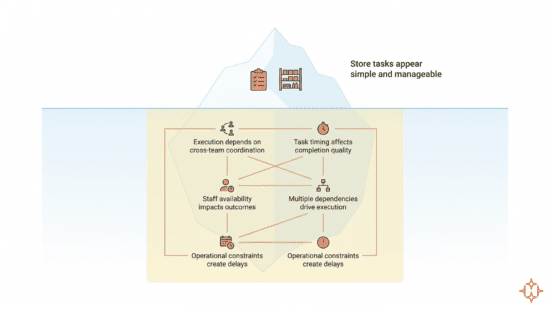
Why traditional NPS analysis misses the root cause
Most NPS reviews are conducted:
- Weekly or monthly
- At store or region level
- Without execution context
This makes it difficult to distinguish between:
- Experience design issues
- Operational breakdowns
- Temporary overload conditions
As a result, retailers often respond with broad initiatives such as retraining or policy changes, when the real issue is capacity at specific moments.
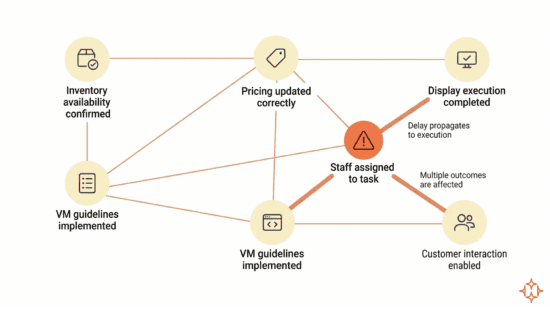
Making stress visible changes the conversation
Retailers that integrate execution data with experience metrics begin to see NPS differently.
By correlating NPS with:
- Staffing coverage by time window
- Task load density
- Queue lengths and dwell times
- Assistance availability in premium zones
They uncover patterns such as:
- Predictable NPS dips during high-load periods
- Stores where stress is episodic, not constant
- Teams that perform well until a threshold is crossed
In several deployments, this approach has helped retailers improve peak-hour NPS by 5–10 points without increasing headcount.
Where HipHip fits in
HipHip makes it possible to observe how store conditions evolve during the day.
It captures how customer movement, staff activity, and service delays interact in real time.
This helps teams understand:
- When pressure begins to build
- Where it concentrates inside the store
- How it affects customer interaction
Instead of relying only on feedback after the experience, teams can identify stress as it develops and respond before it impacts service quality.
Conclusion
Customer experience does not fail in isolation.
It breaks under pressure.
When teams cross a certain threshold of workload, the quality of interaction drops, even if everything else in the store remains unchanged.
Looking at NPS without understanding these conditions leads to incomplete conclusions.
The real opportunity lies in identifying when pressure builds, understanding what drives it, and responding before it affects the customer experience.
For retailers evaluating how execution visibility and workload signals can be used alongside NPS to strengthen customer experience at scale, you can reach us at [email protected].
About HipHip.AI
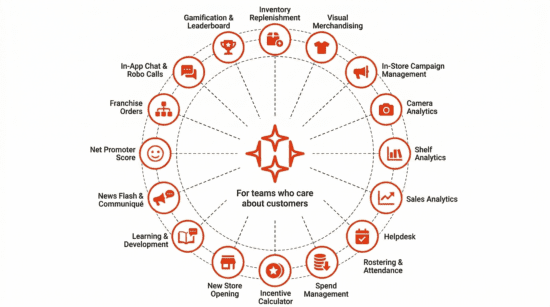
HipHip.AI is an AI-powered, end-to-end retail execution platform used across 10,000+ retail brick and mortar stores. It unifies inventory, merchandising, campaign management, store teams, and store spend into a single operating system—enabling real-time visibility and execution across stores.
Core capabilities include:
- Inventory Replenishment
- Visual Merchandising
- In-Store Campaign Management
- Camera Analytics
- Shelf Analytics
- Sales Analytics
- Helpdesk
- Task Manager
- Rostering & Attendance
- Spend Management
- Incentive Calculator
- New Store Opening
- Learning & Development
- News Flash & Communiqué
- Net Promoter Score
- Franchise Orders
- In-App Chat & Robo Calls
- Gamification & Leaderboard
HipHip.AI integrates seamlessly with existing POS, ERP, WMS, and HRMS systems, ensuring zero disruption to current infrastructure while unlocking smarter, faster retail execution.
Talk to an expert → hiphip.ai
Frequently asked questions
- If staffing levels are technically adequate, why does experience still break down during certain periods?
Because adequacy is measured in isolation, while experience is shaped by concurrency.
A store may have the right number of people on the floor, but if multiple high-effort tasks converge within the same time window, the effective capacity drops. Staff are forced to switch context repeatedly, which slows response time, reduces attention quality, and increases error likelihood.
What appears as sufficient staffing on paper becomes insufficient in practice because the system does not account for how work is distributed in time.
- How should leaders differentiate between a capability issue and a stress-induced breakdown?
The distinction lies in consistency.
If performance remains weak across all time periods, it typically indicates a capability or training gap. However, if the same team performs well during low-load periods and deteriorates only under peak conditions, the issue is not skill, but load management.
This is critical because the intervention differs. Capability issues require training. Stress-related breakdowns require reallocation of work, clearer role separation, or changes in timing.
- Why do improvements in staffing or training often fail to improve NPS in a sustained way?
Because these interventions assume the problem is constant.
In reality, most experience breakdowns are episodic. They occur when demand, task load, and staff availability become misaligned for short periods of time.
Adding staff uniformly or retraining teams broadly does not address these specific windows. As a result, improvements appear temporarily but do not hold, because the underlying timing mismatch remains unresolved.
- How can the business impact of staff stress be understood in measurable terms?
The most direct way is to examine the gap between demand and conversion during high-load periods.
If footfall remains stable or increases but transaction rates, assisted selling, or basket sizes drop during the same window, the difference represents lost revenue caused by execution constraints.
This reframes stress from an HR concern to a revenue problem, tied directly to how effectively demand is converted under pressure.
- At what point does staff stress become a systemic issue rather than a store-level problem?
It becomes systemic when similar patterns appear across multiple stores under similar conditions.
For example, if multiple locations experience NPS drops during the same trading windows or under similar campaign conditions, it suggests a structural issue in operating rhythm, staffing models, or task design.
At that point, solving at the store level will not be sufficient. The problem needs to be addressed at the network level.
- What changes operationally when stress is made visible in real time?
The nature of decision-making shifts.
Instead of reviewing outcomes after the fact, teams begin to manage conditions as they develop. Store managers can identify when pressure is building, adjust task priorities, reallocate attention, and intervene before the experience deteriorates.
This reduces reliance on retrospective analysis and enables more precise, moment-level control over execution.