


How one of India’s largest luggage company improved store-ops execution
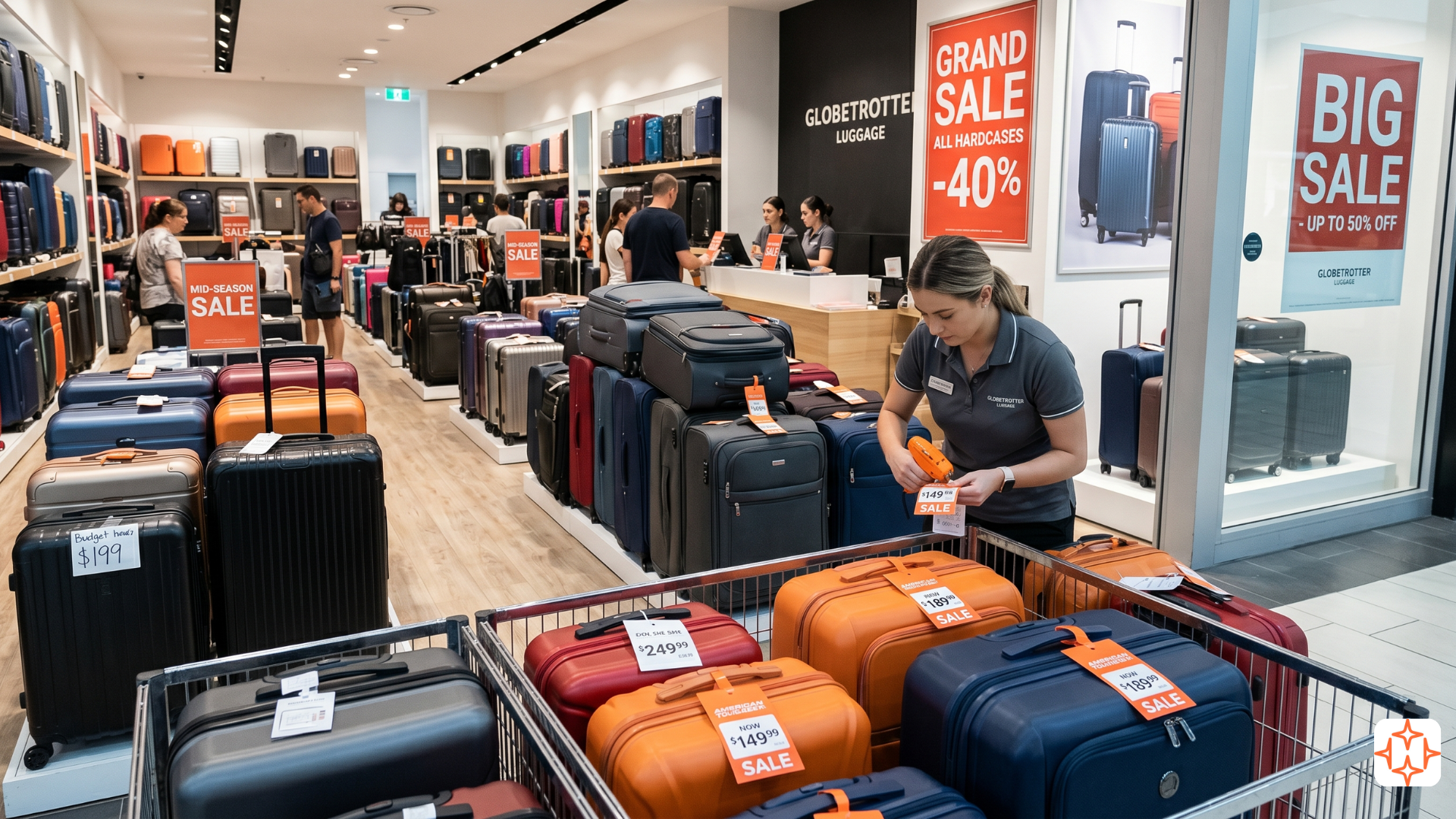
One of India’s largest luggage manufacturers, with a retail presence spanning 1000+ outlets across the country, runs frequent nationwide campaigns across its store network.
During a sale campaign: Posters at the entrance are updated
But Inside the store:
- Some suitcases still carry old MRP tags
- A ₹6,999 hardcase is placed in the discount section
- One rack continues displaying previous campaign stock
Stores mark the campaign as “completed,” and similar gaps are observed across multiple locations.
Based on our experience of working with 20,000+ retailers globally, similar execution patterns are observed across large store networks.
This case study outlines how these execution gaps across a 1000+ store network were addressed through a structured execution workflow.
With HipHip.AI’s Ops Checklist in place, campaign execution becomes consistent across stores, and issue resolution timelines reduce from multiple days to under 24 hours.
The impact of structured execution becomes clearer when viewed across the entire store network:
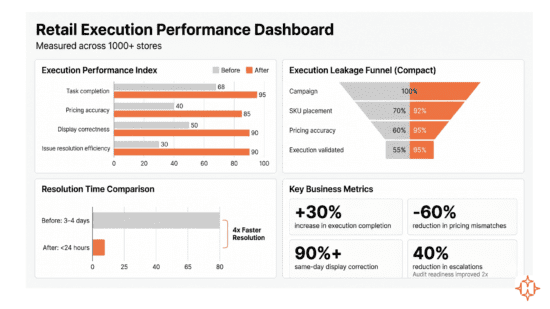
The following sections break down how these improvements are achieved at the store level.
Execution challenges for the brand
Scenario 1:
A price list covering 20–25 SKUs is shared with stores, typically circulated over email or messaging groups.
In-store:
- Staff refers to the list on their phone or a printed sheet
- Price stickers are printed from the back office and applied across displayed luggage
The process moves rack by rack, with tags manually removed and replaced.
Midway through execution, customer footfall increases and staff shifts to billing counters. The tagging activity either pauses or less people are working on it now.
When the floor is revisited:
- Most visible SKUs are updated
- A few pieces on lower racks or side displays remain unchanged
At billing:
- A customer brings a suitcase to the counter
- The physical tag shows ₹5,499
- The billing system reflects ₹4,199
The difference is explained verbally at checkout. There is no consolidated view of which SKUs were updated and which were missed across the store network.
Scenario 2:
Display guidelines are shared with a reference image specifying three SKUs for the entrance display.
In-store:
- Staff refers to the image on their phone
- Two SKUs are picked from available stock and placed correctly
- The third SKU is not available on the shop floor
Instead:
- A similar older model is selected from the backroom
- The display is completed using available inventory
Reason:
- “This one sells faster”
- “New carton is still in storage”
There is no mechanism to verify whether displays across stores match the defined guidelines.
Scenario 3:
In another instance, a store receives damaged luggage during inward stock movement:
- A trolley bag with a broken wheel
- A hardcase with visible scratches
The items are not immediately removed from the floor.
- They are placed on a side rack
- An image is clicked and shared on WhatsApp
The message moves:
- Store → Regional manager → Ops group
Over the next few days:
- Updates are shared across message threads
- Follow-ups happen intermittently
- Tickets may be created, but remain spread across non-trackable systems
- No ownership is assigned
- No pickup timeline is confirmed
There is no single system tracking the issue from identification to resolution, and the damaged products remain on display.
These patterns repeat across a large store network and across campaigns, making execution dependent on how each store interprets and completes tasks.
This case study examines how these execution challenges are resolved with HipHip.AI’s AI-driven Ops Checklist.
How execution changed with HipHip.AI’s Ops Checklist
After implementing HipHip.AI’s AI-driven Ops Checklist, campaign execution is structured as a centrally tracked workflow across the entire store network.
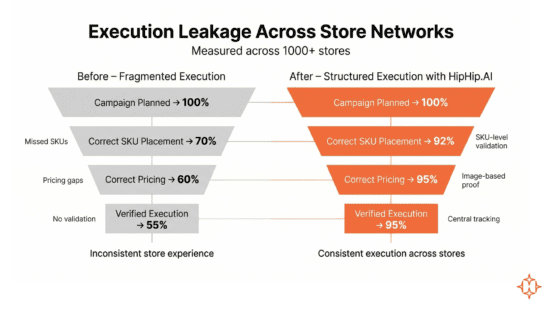
Each task includes specific SKUs for pricing, exact display instructions, and reference images of the expected setup.
In-store, staff works through tasks sequentially.
- For pricing: Close-up images of each updated tag are uploaded
- For display:
- Rack image is uploaded
- Entrance view is uploaded
All submissions are visible centrally, enabling immediate identification of stores with incomplete or incorrect execution.
If a display has the wrong SKU or a tag is missing, the task is returned with a clear instruction:
- “Replace with SKU X130”
- “Update tag for X124”
The store corrects the issue and re-uploads before completion is accepted.
If required items are unavailable, such as a display stand or product, the issue is logged within the same workflow with an image.
- It is assigned
- Tracked
- Updated until resolution
The checklist is deployed simultaneously across the entire store network, ensuring consistent execution across locations.
The shift (Before vs After)
| Before | After implementing HipHip.AI’s Ops Checklist |
| Tags partially updated | Each SKU validated through image proof |
| Wrong SKUs placed | Display checked against reference images |
| “Done” reported on calls | Completion accepted only after validation |
| Issues forwarded across chats | Issues logged with ownership and tracking |
| Damaged luggage remains on floor | Replacement tracked to closure |
| HO depends on updates | HO sees real store execution in real time |
These changes translate into measurable improvements across key execution metrics:
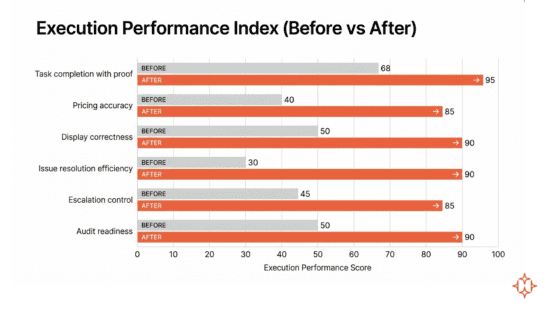
Operational impact
Across a large store network, small execution gaps compound and reduce overall campaign effectiveness:
- Task completion with proof increases from ~65–70% to 95%+
- Pricing mismatches reduce by ~60% across the store network
- Incorrect campaign displays corrected the same day in 90%+ locations
- Issue resolution time reduces from 3–4 days to under 24 hours
- Escalations from stores reduce by ~40%
- Audit readiness improves by 2x across regions
Business Impact
Improvements in execution begin to translate into business outcomes across the store network.
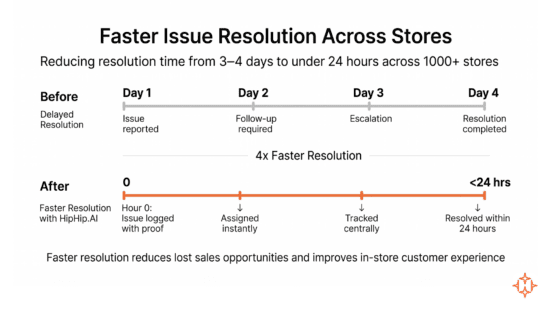
With HipHip.AI’s Ops Checklist in place, execution improvements translate directly into measurable business outcomes across the store network.
- Campaigns are executed consistently across locations, improving overall campaign effectiveness
- Promoted products receive correct placement and visibility, driving better sell-through
- Pricing consistency across stores reduces billing discrepancies and improves customer trust
At a network level:
- Revenue leakage caused by execution gaps is significantly reduced
- Campaign ROI becomes more predictable due to uniform execution
- Store-to-store variation in execution is minimized, improving overall performance consistency
Central teams operate with greater control and efficiency.
- Less time is spent on coordination and follow-ups across stores
- Issues are resolved within defined timelines, reducing operational delays
- Store performance is evaluated based on actual execution, improving accountability
Execution remains dependent on store teams, but is now supported by a structured system that improves visibility, accountability, and consistency across the network.
This continues to shape how campaigns are rolled out and monitored across stores, with central teams relying on execution data to manage performance and address gaps as they occur.
What this looks like at scale
This case study reflects how structured execution can be scaled across large store networks to improve consistency, visibility, and control.
Across a large store network, execution now follows a more structured and trackable approach, with central teams able to monitor and manage how campaigns are implemented at the store level.
- Campaigns are executed as defined
- Gaps are identified during execution
- Issues move with ownership and closure timelines
What was previously distributed across calls, messages, and store updates now operates within a single workflow that connects planning with execution.
Over time, this enables more consistent rollout of campaigns and clearer visibility into store-level execution across the network.
HipHip.AI’s AI-driven Ops Checklist continues to support this by acting as the execution layer between central planning and what happens in stores.
About HipHip.AI
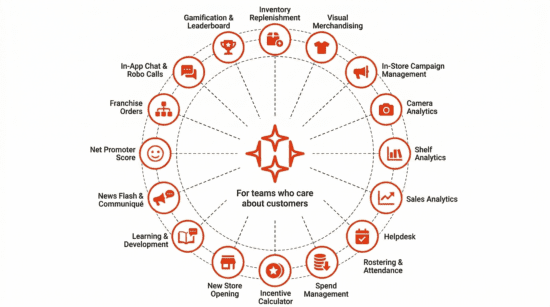
HipHip.AI is an AI-powered, end-to-end retail execution platform used across 10,000+ retail brick and mortar stores. It unifies inventory, merchandising, campaign management, store teams, and store spend into a single operating system—enabling real-time visibility and execution across stores.
Core capabilities include:
- Inventory Replenishment
- Visual Merchandising
- In-Store Campaign Management
- Camera Analytics
- Shelf Analytics
- Sales Analytics
- Helpdesk
- Task Manager
- Rostering & Attendance
- Spend Management
- Incentive Calculator
- New Store Opening
- Learning & Development
- News Flash & Communiqué
- Net Promoter Score
- Franchise Orders
- In-App Chat & Robo Calls
- Gamification & Leaderboard
HipHip.AI integrates seamlessly with existing POS, ERP, WMS, and HRMS systems, ensuring zero disruption to current infrastructure while unlocking smarter, faster retail execution.
Talk to an expert → hiphip.ai