


Real-Time VM Alerts vs Manual Audits

Across the retail networks we work with at HipHip, one pattern shows up again and again:
VM issues are rarely invisible. They are simply discovered after the damage is done.
By the time a regional manager notices a problem, the campaign is already live.
By the time an audit report is reviewed, customers have already seen the wrong display.
By the time an escalation reaches head office, the same issue has repeated across multiple stores.
This happens not because teams don’t care, but because manual audits are designed to look backward, while VM execution happens every day, in real time.
Why manual VM audits fall behind execution
In most retail organizations, VM audits follow a familiar structure:
- scheduled store visits,
- checklist-based reviews,
- photo submissions,
- reports shared days or weeks later.
From our experience working with multi-store retail brands, audits work well for documentation, but poorly for prevention.
They answer: “What went wrong last week?”
They fail to answer: “What is breaking right now, and where should we intervene?”
As store networks scale, this delay becomes the biggest reason VM issues surface late.
At a structural level, the difference is not just in method, but in timing.
Manual audits operate on a delayed cycle. Execution happens continuously, but validation happens intermittently.Real-time systems collapse this gap by aligning validation with execution itself.
This is why the same issue that would typically be discovered days later in an audit can now be identified within minutes of execution.
How real-time VM alerts helps
At HipHip, we’ve learned that real-time VM alerts only work when they are execution-aware, not activity-based.
Real-time VM alerts are not generic notifications.
They are signals raised only when VM execution breaks defined standards.
In practice, this means:
- alerts are triggered by execution validation, not time schedules,
- alerts include visual proof, not just scores,
- alerts are routed to the right role, not broadcast to everyone,
- alerts are rare, focused, and immediately actionable.
This distinction is critical. Many retailers already have alerts. Most of them are ignored.
Real-time VM alerts vs manual audits
Based on what we’ve seen across retail clients:
Manual audits
- surface issues days or weeks later,
- depend heavily on store visits and manual review,
- struggle to scale beyond a point,
- often create escalations instead of preventing them.
Real-time VM alerts (enabled by HipHip)
- detect issues at the moment of execution,
- validate VM using AI and photo proof,
- scale automatically across hundreds of stores,
- prevent escalations by catching issues early.
Example: In one network, a recurring issue with promotional signage placement was typically identified during weekly audits. By the time it surfaced, the same mistake had already appeared across multiple stores.
With execution-linked alerts in place, the same deviation was flagged within hours of rollout in the first few stores. The issue was corrected before it propagated further, reducing both repetition and escalation.
How HipHip.AI enables real-time VM alerts
One insight we’ve consistently seen: alerts don’t work in isolation. They work only when built on top of a strong execution system.
HipHip.AI enables real-time VM alerts through three layers.
1. Image-led VM guidance
Across clients, a large percentage of VM errors disappear once store teams are shown exactly what “right” looks like.
HipHip.AI replaces ambiguous text with visual guidance, reducing interpretation before execution even happens.
2. AI-led execution validation
When store teams complete VM tasks, they upload photo proof.
HipHip’s AI validates execution instantly against VM guidelines, with configurable thresholds based on store type and campaign.
This replaces delayed audits with immediate feedback.
3. Exception-based real-time alerts
Only when execution falls outside defined thresholds does HipHip.AI trigger a real-time alert.
Each alert includes:
- visual proof,
- reason codes,
- and is routed to the appropriate role.
This is why alerts remain actionable and don’t turn into noise.
Helping everyone to deliver results
Store Manager
In one retail network, store managers started receiving immediate alerts when a campaign display missed a critical element.
Instead of waiting for a visit or escalation, managers fixed issues within hours.
Most issues never reached regional teams.
Regional VM Manager
A regional VM manager overseeing over 100 stores previously spent hours reviewing audit photos.
With HipHip, they now see alerts for only a small subset of stores where execution deviates.
Time shifts from reviewing compliance to improving execution.
Head of Retail
During a nationwide campaign rollout, one brand used real-time alerts to track execution daily.
Instead of post-campaign firefighting, issues were corrected mid-rollout, resulting in far fewer escalations and a smoother launch.
| Store Teams |
|
| Store Managers |
|
| Regional / VM Heads |
|
| Head of Retail / Brand |
|
The advantage is not visibility, it is timing
Most retail systems today can tell you what went wrong. Very few can tell you in time to do something about it.
This is the fundamental limitation of manual audits. They are accurate, but late.
In VM execution, timing is not a secondary factor. It defines impact. A display corrected after peak hours is not a fix. It is a missed opportunity already accounted for.
Real-time alerting changes this dynamic by shifting detection closer to execution.
But speed alone is not enough.
What matters is whether signals are meaningful, actionable, and limited to what actually needs attention.
When that happens, teams stop reacting to issues. They start containing them before they spread.
For organizations looking to move from manual VM audits to real-time, execution-aware alerts, the HipHip.AI team can be reached at [email protected]
About HipHip.AI
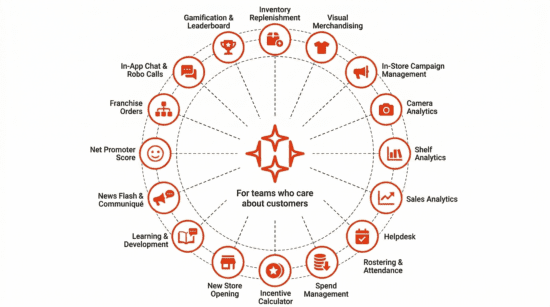
HipHip.AI is an AI-powered, end-to-end retail execution platform used across 10,000+ retail brick and mortar stores. It unifies inventory, merchandising, campaign management, store teams, and store spend into a single operating system—enabling real-time visibility and execution across stores.
Core capabilities include:
- Inventory Replenishment
- Visual Merchandising
- In-Store Campaign Management
- Camera Analytics
- Shelf Analytics
- Sales Analytics
- Helpdesk
- Task Manager
- Rostering & Attendance
- Spend Management
- Incentive Calculator
- New Store Opening
- Learning & Development
- News Flash & Communiqué
- Net Promoter Score
- Franchise Orders
- In-App Chat & Robo Calls
- Gamification & Leaderboard
HipHip.AI integrates seamlessly with existing POS, ERP, WMS, and HRMS systems, ensuring zero disruption to current infrastructure while unlocking smarter, faster retail execution.
Talk to an expert → hiphip.ai
Frequently asked questions
What is the difference between real-time VM alerts and manual audits?
Manual audits review VM execution after the fact, often days or weeks later. Real-time VM alerts detect execution issues at the moment they occur, allowing teams to fix problems before they impact customers or escalate.
Do real-time VM alerts replace audits completely?
Real-time VM alerts significantly reduce the need for routine audits. Audits shift from being the default control mechanism to being exception-based, used only when alerts indicate deeper issues.
Will real-time alerts create alert fatigue for managers?
No, when designed correctly. HipHip.AI uses exception-led alerting, meaning managers see only high-impact deviations instead of alerts from every store. This reduces noise rather than increasing it.
How do real-time VM alerts help store managers?
Store managers get early visibility into issues they can fix immediately, without waiting for audits or escalations. This helps them correct execution faster and reduces pressure from follow-ups.
How do regional or VM heads benefit from real-time alerts?
Regional and VM heads can focus only on non-compliant or at-risk stores instead of reviewing every store. This shifts their role from chasing compliance to improving execution quality.
How do real-time VM alerts work during campaign rollouts?
During campaigns, alerts help detect execution gaps early, while the rollout is still in progress. This prevents last-minute escalations and post-campaign firefighting.