


HipHip.AI vs Pazo: Which retail ops platform is right for you?

Running retail operations across multiple stores requires strong compliance, consistent execution, and clear visibility at every level. The platform you choose to manage this shapes how your teams perform and how confidently your leadership can make decisions.
Pazo is built around structured compliance: geo-tagged checklists, verified task execution, and remote VM audits that give ops teams a reliable way to enforce standards across stores.
HipHip.AI does all of this, and goes further. Beyond checklists and compliance, it connects store execution with inventory, workforce, campaigns, and shopper analytics, giving retail leaders a complete operational and commercial picture in one platform.
Both platforms help retail brands run tighter operations. But their scope, depth, and what they ultimately deliver are very different. Here’s how they compare.
Where HipHip.AI and Pazo stand on core retail functions
Both HipHip.AI and Pazo offer a strong foundation for store operations: digital daily checklists, role-based task assignment, multi-level escalations, proof of completion with photos and videos, auto-ticketing on checklist failure, and in-app messaging tied to tasks.
For any retail brand looking to move away from manual, WhatsApp-based ops, either tool gets you there. Where they start to differ is in how intelligent the checklist layer is, and more importantly, what it connects to.
| Feature | HipHip.AI | Pazo |
| Task tracking | ✅ | ✅ |
| Predictive alerts for delays | ✅ | ✅ |
| Training gaps identification | ✅ | ❌ |
| Offline capability | ✅ | ✅ |
| Geo-tagging | ✅ | ✅ |
Where the two platforms truly diverge is in how the checklist layer connects to the rest of store operations. Here is how each tool performs across the key functions.
Visual merchandising
Both tools support VM compliance through photo validation and AI scoring. HipHip.AI extends this into a full VM management workflow.
| HipHip.AI | Pazo | |
| Zone-specific VM checklists for facades, mannequins, racks, fitting rooms, and displays | ✅ | ❌ |
| AI-powered photo compliance scoring | ✅ | ✅ |
| Before and after photo comparisons for refresh campaigns | ✅ | ❌ |
| Centralised visual proof library with correction timeline | ✅ | ❌ |
| Customer-facing QR for VM issue reporting | ❌ | ✅ |
| POSM tracking with live courier integration and damage or delay alerts | ✅ | ❌ |
| Gamification and leaderboards for VM task completion | ✅ | ❌ |
| End-cap management | ❌ | ✅ |
| Digital artwork push for local printing | ✅ | ❌ |
| Remote VM verification without a store visit | ✅ | ✅ |
| Region-wise VM compliance dashboards | ✅ | ✅ |
| Exportable compliance reports in PDF and PPT | ✅ | ✅ |
Campaign management
Both tools support new product launch workflows with checklists and training. HipHip.AI goes further by managing the entire campaign lifecycle across multiple simultaneous rollouts.
| HipHip.AI | Pazo | |
| New product launch workflow with guided checklists | ✅ | ✅ |
| Campaign-linked staff quizzes and readiness checks | ✅ | ✅ |
| Multiple overlapping campaigns running simultaneously | ✅ | ❌ |
| Campaign calendar view with activation and compliance tracking | ✅ | ❌ |
| Customer-facing campaign feedback capture | ❌ | ✅ |
| Multi-channel notifications for campaign roadblocks | ✅ | ❌ |
| Campaign ROI measurement linking compliance with shopper engagement and sales uplift | ✅ | ❌ |
| Pilot rollouts by store or region before full launch | ✅ | ❌ |
| Gamified campaign learning for store staff | ✅ | ❌ |
| Single campaign workflow support | ✅ | ✅ |
Workforce management
Pazo’s workforce capability is limited to geo-tagged task verification. HipHip.AI offers a complete workforce management module built directly into the ops layer.
| HipHip.AI | Pazo | |
| Geo-tagging for task verification | ✅ | ✅ |
| Year-ahead manpower planning by store and region | ✅ | ❌ |
| Auto-rostering based on footfall and seasonality | ✅ | ❌ |
| External auditor access mode | ❌ | ✅ |
| Face ID and geofence-based attendance | ✅ | ❌ |
| Real-time attendance monitoring and location tracking | ✅ | ❌ |
| Leave management and shift visibility | ✅ | ❌ |
| Planned vs actual staffing comparison | ✅ | ❌ |
| Attendance correlated with store performance | ✅ | ❌ |
| Dedicated workforce management module | ✅ | ❌ |
Inventory and replenishment
Pazo does not offer inventory management capabilities. HipHip.AI connects checklist execution directly to stock visibility and replenishment workflows.
| HipHip.AI | Pazo | |
| Store-level demand prediction per SKU using live POS and WMS data | ✅ | ❌ |
| Demand forecasting for new launches, seasonal peaks, and special events | ✅ | ❌ |
| Smart inter-store transfers | ✅ | ❌ |
| Overstock, shortage, and slow mover identification | ✅ | ❌ |
| Vendor-side replenishment acknowledgment portal | ❌ | ✅ |
| Inventory tracking from warehouse to store with audit-ready logs | ✅ | ❌ |
| Franchise ordering with seasonal recommendations | ✅ | ❌ |
| Integrations with Oracle Retail, Lightspeed, Shopify POS, Square, and MS Dynamics | ✅ | ❌ |
| Inventory and replenishment module | ✅ | ❌ |
Analytics and reporting
Both tools offer real-time ops dashboards and exportable reports. HipHip.AI goes beyond compliance reporting into unified commercial intelligence.
| HipHip.AI | Pazo | |
| Real-time ops dashboards | ✅ | ✅ |
| AI alerts for missed tasks and non-compliance | ✅ | ✅ |
| Exportable PDF and PPT reports | ✅ | ✅ |
| Google Sheets and MIS sync | ❌ | ✅ |
| Unified dashboards across inventory, VM, campaigns, workforce, and finance | ✅ | ❌ |
| One-click PPT audit deck generation | ❌ | ✅ |
| Deviation intelligence surfacing what went wrong, not just completion rates | ✅ | ❌ |
| Store heatmaps and performance gap tracking | ✅ | ❌ |
| Shopper analytics and NPS by store | ✅ | ❌ |
| Footfall and traffic pattern tracking | ✅ | ❌ |
| Role-specific views for store, cluster, and HQ built into the platform | ✅ | ❌ |
Store manager
A store manager’s day revolves around ensuring tasks are done, displays are correct, and the team is performing. Here is what each platform delivers at the store level.
| HipHip.AI | Pazo | |
| Daily tasks assigned and tracked by role | ✅ | ✅ |
| Geo-tagged and time-stamped task verification | ✅ | ✅ |
| Auto-escalation for missed or delayed tasks | ✅ | ✅ |
| Real-time visibility on what is pending, in progress, and verified | ✅ | ✅ |
| VM compliance tracked by store zone | ✅ | ❌ |
| Automatic micro-training when a task or checklist fails | ✅ | ❌ |
| Staff attendance and shift visibility in one place | ✅ | ✅ |
| Stock availability and replenishment status at store level | ✅ | ❌ |
Cluster / Regional manager
A cluster manager needs to see what is happening across multiple stores without being on the ground. Here is what each platform delivers at the regional level.
| HipHip.AI | Pazo | |
| Cross-store task completion and compliance tracking | ✅ | ✅ |
| VM compliance scores across stores and regions | ✅ | ✅ |
| Deviation intelligence — what went wrong and where | ✅ | ❌ |
| Multiple campaigns tracked simultaneously across regions | ✅ | ❌ |
| Planned vs actual staffing visibility by store | ✅ | ❌ |
| Inventory gaps and replenishment status by store | ✅ | ❌ |
| Campaign ROI by region | ✅ | ❌ |
| Faster audits with centralised visual proof and correction timeline | ✅ | ❌ |
Head of retail / Leadership
Leadership needs the full picture: execution, compliance, commercial outcomes, and team performance across the entire retail network. Here is what each platform delivers at that level.
| HipHip.AI | Pazo | |
| Unified view across ops, VM, inventory, workforce, and finance | ✅ | ❌ |
| Store-level NPS correlated with sales and service data | ✅ | ❌ |
| Footfall, dwell time, and shopper behaviour by store | ✅ | ❌ |
| Campaign compliance linked to sales uplift and ROI | ✅ | ❌ |
| Franchise vs company-owned store performance comparison | ✅ | ❌ |
| Execution data connected to commercial outcomes | ✅ | ❌ |
| Compliance and ops dashboards across all stores | ✅ | ✅ |
| Scalable across hundreds of stores without additional setup | ✅ | ✅ |
Summary
Pazo and HipHip.AI are both built for retail operations and bring genuine capability to store compliance, task management, and VM execution. Where they diverge is in scope and depth.
HipHip.AI does everything Pazo does, and goes further as a true end-to-end retail operations platform that connects every layer of your business:
- Complete workforce management including rostering, attendance, shift planning, and deployment
- Inventory intelligence covering demand forecasting, replenishment, and stock visibility by store
- Campaign management across multiple simultaneous rollouts with ROI tracking
- Shopper and footfall analytics connected to in-store execution
- Unified dashboards across ops, inventory, workforce, VM, campaigns, and finance in one place
For retail brands that need more than compliance tracking, a platform that connects execution to commercial outcomes across every store, every team, and every function, HipHip.AI is the end-to-end solution built for that scale.
About HipHip.AI
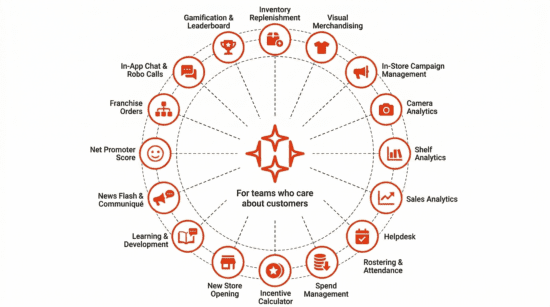
HipHip.AI is an AI-powered, end-to-end retail execution platform used across 10,000+ retail brick and mortar stores. It unifies inventory, merchandising, campaign management, store teams, and store spend into a single operating system—enabling real-time visibility and execution across stores.
Core capabilities include:
- Inventory Replenishment
- Visual Merchandising
- In-Store Campaign Management
- Camera Analytics
- Shelf Analytics
- Sales Analytics
- Helpdesk
- Task Manager
- Rostering & Attendance
- Spend Management
- Incentive Calculator
- New Store Opening
- Learning & Development
- News Flash & Communiqué
- Net Promoter Score
- Franchise Orders
- In-App Chat & Robo Calls
- Gamification & Leaderboard
HipHip.AI integrates seamlessly with existing POS, ERP, WMS, and HRMS systems, ensuring zero disruption to current infrastructure while unlocking smarter, faster retail execution.
Talk to an expert → hiphip.ai
Frequently asked questions
- Can Pazo do everything HipHip.AI does, just with third-party integrations? Pazo is built to do ops compliance exceptionally well. Where HipHip.AI goes further is in scope. These functions are native to HipHip.AI but outside what Pazo is designed to cover:
- Workforce planning and attendance management
- Inventory visibility and replenishment
- Campaign ROI tracking
- Shopper and footfall analytics
For retail brands that need these functions connected to their ops layer, HipHip.AI covers the full stack in one platform.
- We already use a separate WMS and HRMS. Does HipHip.AI replace those or work alongside them?
It works alongside them. HipHip.AI integrates with Oracle Retail, Lightspeed, Shopify POS, MS Dynamics, and standard WMS and HRMS setups. What changes is how that data reaches the people who need it:
- A staffing gap from your HRMS becomes visible alongside task completion data
- A stock shortage from your WMS surfaces in the same ops view as replenishment workflows
- Regional managers and HQ work from one picture, not across multiple platforms
- If our current priority is just getting stores off WhatsApp-based ops, is Pazo a better starting point?
Both platforms solve that well. The question worth asking at a leadership level before making that call:
- Will you need workforce, inventory, or commercial reporting in the next 18 months?
- What does a platform migration look like across hundreds of stores, with data continuity and retraining?
- Is a faster deployment today worth a potential switching cost later?
If the scope stays limited to compliance, both platforms serve that need. If it grows, HipHip.AI is already built for it.
- How does HipHip.AI handle VM compliance differently from Pazo?
Both platforms support photo-based VM compliance and AI scoring. HipHip.AI extends this into a full VM execution workflow:
- Zone-specific checklists across facades, mannequins, racks, and fitting rooms
- POSM tracking from courier to store with damage and delay alerts
- Before and after photo comparisons for refresh campaigns
- Display compliance linked to shopper engagement data
For a Head of Retail, this means visibility not just into whether VM is compliant, but whether VM investment is driving commercial outcomes.
- Is HipHip.AI’s workforce management module relevant if we already have an HR system?
Yes, because what an HR system tracks and what an ops leader needs in the moment are different things:
- Which stores are running below planned headcount right now
- Whether a staffing gap is correlating with task escalations or VM compliance drops
- How actual deployment compares to planned, by store and region
HipHip.AI surfaces this inside the ops layer, alongside everything else a regional manager or Head of Ops is already tracking.