


Retail SOPs and ops checklists: the complete guide for multi-store brands

Retail ops systems were built to track activity. Not to verify execution. At scale, that design choice has a compounding cost that shows up everywhere except the dashboard.
As execution data moves up the retail hierarchy, it gets averaged, summarized, and stripped of the deviations that actually matter. What reaches the top is a clean view of a messy reality. Stores appear compliant. Campaigns appear executed. The in-store experience tells a different story.
This is a systems problem.
This guide breaks that system down. How SOPs and checklists work together. Where the structure fails at scale. What those failures cost. And what it looks like when execution is built to hold across every store.
SOPs and checklists are two different instruments
Most retail organizations treat them as variations of the same thing. They are not.
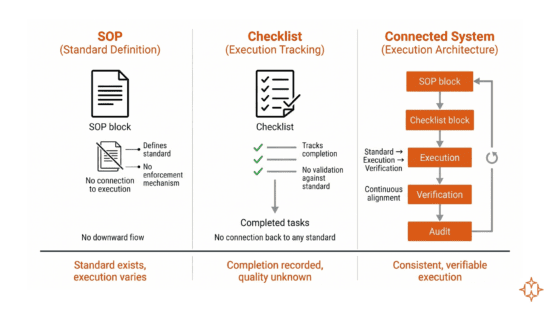
An SOP defines the standard: what good looks like, who is responsible, and what the brand expects at every touchpoint. A checklist operationalizes it: the daily verification that the standard was actually met in a specific store, on a specific day, by a specific team.
When only one exists:
- Checklist without an SOP: a task list with no anchor. Interpretation varies by store, by manager, by shift. Completion is recorded, not whether the standard was met.
- SOP without a checklist: a document that lives in a folder. The standard exists on paper. Nothing verifies it is being met on the floor.
The failure mode that matters most at scale is subtler: both instruments exist, but operate separately. The SOP updates when processes change. The checklist does not. The system looks operational. The brand drifts anyway.
Why the hierarchy breaks the signal
A retail brand operating across hundreds of stores is a hierarchy, each layer working from a different vantage point and needing different things from the same system. The structural problem with most retail ops systems is that they are built for one level of that hierarchy and then expected to serve all of them.
| Hierarchy Level | What Most Systems Actually Deliver | What They Need from the System |
| Store staff | Task completion tracking | Clarity on what to do, when, and in what sequence |
| Area manager | Aggregated completion rates by store | Deviation signals across locations, patterns of late or incorrect execution |
| CXO | Regional rollup dashboards | Brand standards intelligence: whether HQ-defined standards are being met at the last mile |
Completion data moves upward, gets averaged at the cluster level, summarized at the regional level, and consolidated into a dashboard at the top. By the time it reaches leadership, the signal has been smoothed into something that looks like compliance but carries none of the deviation intelligence that would actually enable a decision.
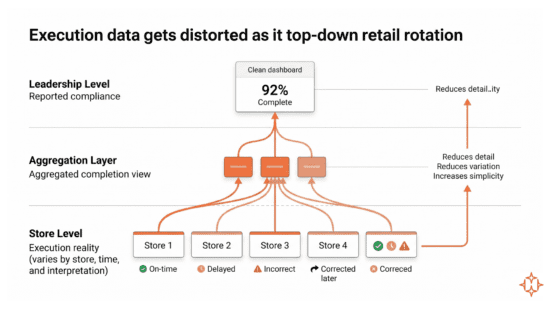
This is the structural failure that keeps completion rates high while execution gaps persist. CXOs are managing a summary, not a reality.
Completion is not execution
Retail execution rarely breaks in obvious ways. Tasks are not routinely abandoned. What happens instead is subtler: tasks are completed late, corrected after the fact, or executed differently across locations. Each one eventually reaches completion. None of it surfaces as a problem in the dashboard.
Consider a campaign rollout across 500 stores. Display guidelines are shared. Store teams execute. By end of day, most stores report the campaign as complete. What the completion data does not capture:
- In some stores, setup was completed before opening as expected
- In others, key elements were still being placed after the store had already opened
- In others, guidelines were interpreted loosely and corrected mid-day
The checklist reflects the same outcome across all of them. Delays become normalized. Corrections become routine. This is exactly how small execution gaps compound into revenue problems before they are ever visible at the top.
What it costs when the system breaks
Four failure modes, each with a distinct cost structure and a distinct point of intervention.
- SOP-checklist disconnect: When the SOP changes and the checklist does not, execution diverges from the current standard silently. Most damaging during launches, seasonal peaks, and compliance windows, the moments when consistency matters most.
- Zero visibility on task completion: A percentage of checklist completion at scale is not real execution. Tasks marked done without proof. When the system only records completion, reported compliance diverges from actual compliance. The CXO’s data becomes noise.
- Hierarchy blindness: The issue is visible at the store level, invisible at the cluster level, and irrelevant by the time it reaches the dashboard. Underperforming stores stay underperforming because the system never surfaces the specific recurring deviation driving it.
- Expansion fracture: Every new store opened without a mature ops system is a brand standard risk from day one. The fracture builds quietly as each store develops its own interpretation of how things should be done.
These failure modes are not hypothetical. Across a 1000+ store network, they manifest as pricing mismatches at billing, wrong SKUs on display during campaigns, damaged products sitting on the floor for days, and stores that report full compliance while the same three operational issues recur every month.
What a system built for scale actually looks like
The markers of a mature retail ops system are not about the sophistication of the tools. They are about what the system makes possible for each level of the organization.
- Deviation is visible before it becomes a pattern. Gaps are identified at the stage where they occur, not absorbed into completion data and lost.
- SOP updates propagate simultaneously across all locations. When the standard changes, every store’s checklist reflects it immediately. The gap between what the brand intends and what the checklist enforces is closed in hours, not weeks.
- Execution is connected across functions. Task management, issue resolution, workforce performance, training, and incentives operate on the same execution data. When a recurring gap is identified, the system connects it to a training deficit or workforce pattern without requiring a manual investigation.
- New stores inherit the system, not a folder. The standard, checklists, escalation logic, and verification requirements are in place from day one. Expansion extends the system, not the risk.
This is what connecting retail execution into one system actually means at the architectural level. Inconsistency becomes impossible to hide because the system is designed to surface deviation, not smooth it into a compliance score.
How HipHip.AI’s ops checklist closes the gaps
The four failure modes above share a root cause: the ops system was built to record activity, not verify execution or carry intelligence upward. HipHip.AI’s Ops Checklist is built around that distinction.
- SOPs that stay live, not static: When a standard changes, the checklist updates with it. Campaign briefs, planogram revisions, and compliance requirements propagate across the store network as structured, executable tasks, not as PDFs shared over messaging groups.
- Completion that requires proof: Images, inputs, and validations are built into every task, not optional. A task cannot be marked done without evidence that it was done correctly. At scale, the CXO’s compliance data reflects what actually happened in stores, not what store teams reported.
- Visibility that is role-specific by design: The same execution data surfaces as a task guide for store staff, deviation patterns for area managers, and brand standards intelligence for the CXO. Role-based visibility is architectural, not a reporting layer added on top.
- Systems that new stores inherit from day one: Checklists, SOPs, escalation logic, proof requirements, and role assignments are deployed at opening. The brand standards risk that accumulates when new stores build their own operational interpretation is eliminated before it starts.
The decision
The question is no longer whether to improve retail ops. It is whether the current system is architecturally capable of serving the scale the business is building toward.
The test is not whether stores are completing checklists. The real questions are:
- Does the system produce deviation intelligence or just completion data?
- Can a standard change be propagated across 500 stores in a single action?
- Can the CXO draw a line between execution consistency and revenue variance by location?
- Does a new store opening inherit the ops system or inherit a document folder?
For most multi-store retailers, this is where the build vs. buy question actually resolves. Not on features or pricing, but on whether the organization has the capacity to build and maintain that level of architectural sophistication while also running the business.
Closing
Consistent execution at scale is a systems design problem. The brands that solve it build infrastructure that makes inconsistency impossible to hide. The system either carries the right signal, or it does not. At scale, there is no middle ground.
About HipHip.AI
HipHip.AI is an AI-powered, end-to-end retail execution platform used across 10,000+ retail brick and mortar stores. It unifies inventory, merchandising, campaign management, store teams, and store spend into a single operating system—enabling real-time visibility and execution across stores.
Core capabilities include:
- Inventory Replenishment
- Visual Merchandising
- In-Store Campaign Management
- Camera Analytics
- Shelf Analytics
- Sales Analytics
- Helpdesk
- Task Manager
- Rostering & Attendance
- Spend Management
- Incentive Calculator
- New Store Opening
- Learning & Development
- News Flash & Communiqué
- Net Promoter Score
- Franchise Orders
- In-App Chat & Robo Calls
- Gamification & Leaderboard
HipHip.AI integrates seamlessly with existing POS, ERP, WMS, and HRMS systems, ensuring zero disruption to current infrastructure while unlocking smarter, faster retail execution.
Talk to an expert → hiphip.ai
Frequently asked questions
- If our stores are reporting high checklist completion, why does execution still feel inconsistent?
High completion rates only indicate that tasks are being marked as done. They do not confirm whether execution met the defined standard, was done at the right time, or was done correctly the first time.
In most systems, completion is self-reported and not tied to proof or validation. As a result, delays, partial execution, and mid-day corrections all get recorded as successful completion. The data looks clean, but the underlying execution varies significantly across stores.
This is why brands often see strong dashboard metrics alongside inconsistent in-store experience.
- How do we know if our SOPs and checklists are actually connected or just co-existing?
The simplest test is propagation.
If a change in SOP requires manual updates across multiple checklists, documents, or communication channels, the system is not connected. It is dependent on coordination.
In a connected system, a change in the standard should automatically reflect in the corresponding checklist across all stores without manual intervention. If that linkage does not exist, execution will continue against outdated standards even while new SOPs are being shared.
- Why does execution data lose value as it moves up the hierarchy?
Because most systems aggregate before they validate.
Store-level deviations get averaged into cluster-level completion rates, then summarized further at the regional level. By the time data reaches leadership, it reflects trends, not exceptions.
What gets lost is the specific, recurring deviation that actually explains underperformance. Without that, decisions are made on summaries rather than root causes, and the same issues continue to repeat at the store level.
- What is the real cost of a broken retail ops system?
The cost does not show up as a single line item. It spreads across multiple areas:
- Campaign revenue loss due to inconsistent rollout timing and execution
- Margin erosion from pricing errors and incorrect SKU placement
- Increased operational overhead from rework, corrections, and escalations
- Store-level underperformance that cannot be diagnosed from aggregated data
Individually, these appear as operational inefficiencies. At scale, they compound into measurable impact on revenue, margins, and brand consistency.
- Can this system be built internally, or does it require a dedicated solution?
It can be built internally, but the complexity is often underestimated.
A functional system requires:
- real-time linkage between SOPs and checklists
- role-based visibility across hierarchy levels
- proof-based execution validation
- structured data flow that preserves deviations, not just completion
Building and maintaining this alongside running retail operations requires sustained engineering, process ownership, and governance discipline. Most internal systems solve for task tracking but stop short of execution verification and system-wide alignment.
- What should we evaluate before deciding to improve or replace our current system?
The evaluation should focus on system capability, not features.
Key questions include:
- Does the system capture deviations or only completion?
- Can a standard change reflect across all stores immediately?
- Is execution verified with proof or based on self-reporting?
- Can underperformance be traced to specific recurring gaps at the store level?
- Do new stores inherit a fully defined system or build their own way of operating?
If these questions cannot be answered clearly from the current system, the issue is not adoption. It is an architectural limitation.