


Why 30% of Stores Drive Nearly 70% of VM Breakdowns

Visual merchandising is often treated as a chain-wide discipline. When compliance dips, the instinct is to push harder across all stores with tighter guidelines, more audits, or broader communication. The assumption is that VM issues are evenly distributed and require uniform correction.
Based on our experience of working with numerous retail brands across various sectors, VM breakdowns are rarely spread evenly across the chain.
Across large retail networks, a small cluster of stores typically accounts for a disproportionate share of VM deviations. Identifying and addressing these hotspots early often delivers greater impact than blanket enforcement across the entire chain.
In many rollouts, 25 to 40 percent of all VM misses are concentrated in just 10 to 30 percent of stores. The remaining majority of stores perform largely within acceptable limits, with only occasional or minor deviations.
Treating both groups the same creates unnecessary operational load while failing to address the real source of breakdowns.
Why the same stores keep showing up
The same stores tend to surface repeatedly across campaigns and audits because they share underlying structural constraints.
Common contributors include:
- Staff bandwidth limitations: Stores with lean staffing struggle to balance customer service, replenishment, and VM upkeep simultaneously.
- Layout complexity: Larger or irregular store layouts increase the effort required to maintain consistent presentation.
- Managerial span of control: In some locations, managers oversee multiple responsibilities, reducing hands-on VM oversight.
- High operational churn: Frequent staff turnover or rotating teams lead to weaker guideline familiarity and execution consistency.
These conditions do not reflect a lack of effort. They reflect capacity and complexity.
Why broad enforcement does not fix the problem
When VM issues are addressed uniformly, high-performing stores absorb unnecessary overhead while low-performing stores remain constrained by the same structural issues.
This often leads to:
- audit fatigue in compliant stores
- defensive behaviour in underperforming stores
- declining engagement with VM processes overall
More importantly, it delays meaningful improvement. The stores that need targeted support continue to struggle, while the rest of the network sees diminishing returns from additional controls.
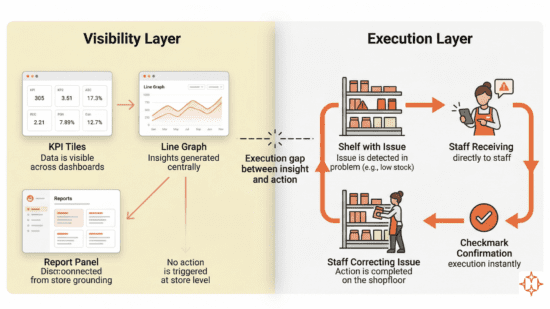
Our industry observations suggest that addressing VM gaps in just the bottom-performing quartile of stores can drive a disproportionate improvement in overall compliance, often without increasing audit frequency or manpower.
The challenge lies in identifying these stores early and objectively.
Why traditional VM reporting falls short
Most VM reporting relies on periodic audits, manual checklists, or self-reported updates. While useful for snapshots, these methods struggle to capture persistence and patterns.
They often answer: Was this store compliant at the time of audit?
But they fail to answer:
- Which stores fail repeatedly?
- Which deviations recur across campaigns?
- Where are gaps temporary versus structural?
Without this distinction, all deviations appear equal, even when their underlying causes are not.
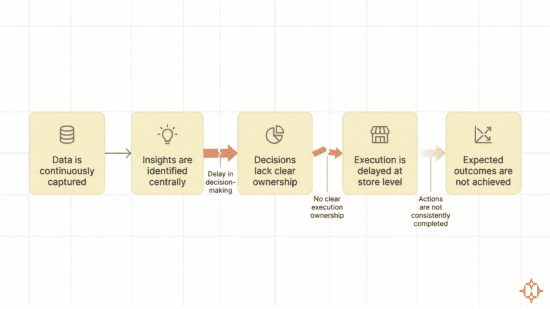
How AI and photo-based validation change the equation
AI-driven VM validation introduces consistency and scale into how execution is measured. Structured photo capture combined with computer vision allows retailers to validate compliance objectively across stores and over time.
Instead of treating each audit in isolation, teams can observe trends:
- which stores deviate most frequently
- which VM elements are repeatedly missed
- how long deviations persist before correction
This shifts VM management from episodic inspection to continuous insight.
What high-performing retailers do differently
Retailers that consistently maintain VM standards at scale tend to follow a different approach. They separate monitoring from intervention.
While monitoring remains broad, intervention is selective. Effort is concentrated where breakdowns are persistent, not where compliance is already stable.
Over time, this creates a virtuous cycle. Chronic hotspots improve, overall variance reduces, and VM processes become easier to sustain across the network.
How HipHip.AI helps identify and fix VM hotspots at scale
The challenge is not visibility alone, but actionable visibility tied to execution. This is where an execution-first VM system like HipHip.AI changes how retailers manage store-level consistency.
Instead of relying on periodic audits, HipHip.AI creates a continuous loop of execution, validation, and visibility across every store.
- Image-led VM execution at store level
Store teams follow structured checklists with visual references, ensuring clarity on what correct execution looks like across displays, props, and layouts. - AI-powered photo validation
Every task is completed with photo proof, which is instantly validated against VM guidelines. This helps identify not just whether a store complied, but how well it complied. - Persistent store-level tracking
Instead of isolated audit snapshots, the system tracks:
- which stores repeatedly deviate
- which elements consistently fail
- how long issues remain unresolved
This makes it easier to distinguish temporary lapses from structural problem stores.
- Real-time visibility for targeted intervention
Regional and central teams can instantly identify the bottom-performing cluster of stores and focus effort where it matters most, instead of applying pressure across the entire network.
The result is a shift from uniform enforcement → precision intervention, where the right stores receive the right level of attention at the right time.
VM breakdown is a distribution problem, not a discipline problem
VM inconsistency across retail networks is rarely a result of weak guidelines or lack of intent. It is a distribution problem, where a small set of structurally constrained stores drives a disproportionate share of breakdowns.
Treating VM as a uniform discipline leads to overcorrection in compliant stores and under-resolution in problem stores.
The shift forward is not more audits or tighter enforcement, but better identification of where breakdowns persist and why.
Retailers that move toward continuous validation and store-level visibility are able to:
- isolate chronic hotspots early
- intervene with precision
- improve compliance without increasing operational burden
In large retail environments, how you allocate attention matters more than how much control you impose.
Retailers that recognize this pattern early are better positioned to protect brand consistency without overburdening their operations.
For retailers evaluating how AI-driven VM validation and execution visibility can help identify and address chronic hotspots, please reach us at [email protected]
About HipHip.AI
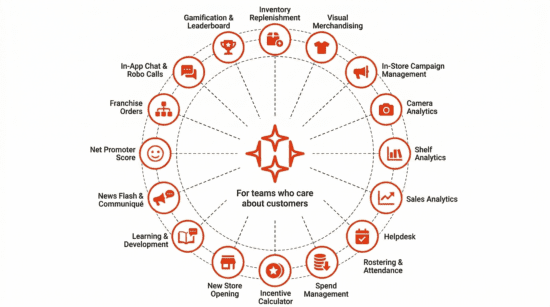
HipHip.AI is an AI-powered, end-to-end retail execution platform used across 10,000+ retail brick and mortar stores. It unifies inventory, merchandising, campaign management, store teams, and store spend into a single operating system—enabling real-time visibility and execution across stores.
Core capabilities include:
- Inventory Replenishment
- Visual Merchandising
- In-Store Campaign Management
- Camera Analytics
- Shelf Analytics
- Sales Analytics
- Helpdesk
- Task Manager
- Rostering & Attendance
- Spend Management
- Incentive Calculator
- New Store Opening
- Learning & Development
- News Flash & Communiqué
- Net Promoter Score
- Franchise Orders
- In-App Chat & Robo Calls
- Gamification & Leaderboard
HipHip.AI integrates seamlessly with existing POS, ERP, WMS, and HRMS systems, ensuring zero disruption to current infrastructure while unlocking smarter, faster retail execution.
Talk to an expert → hiphip.ai
Frequently asked questions
- How can retailers identify which stores are driving most VM breakdowns?
Retailers need more than periodic audit scores. Identifying hotspots requires tracking store performance over time — including frequency of deviations, recurring issues, and resolution delays. AI-led validation systems make these patterns visible at scale. - Why do the same stores repeatedly fail VM compliance?
Repeat failures are usually driven by structural factors such as staffing constraints, layout complexity, or operational overload. Without isolating these stores, uniform enforcement fails to address the root cause - How is AI-based VM validation different from traditional audits?
Traditional audits provide point-in-time snapshots. AI-based validation continuously evaluates execution using photo proof, enabling retailers to track patterns, consistency, and deviation persistence across stores. - Can this approach reduce the need for manual audits?
Yes. When VM execution is continuously validated through structured photo capture and AI scoring, the dependency on frequent manual audits reduces significantly, allowing teams to focus only on exception cases. - How do regional or central teams act on this data?
With real-time dashboards, teams can identify underperforming stores instantly and prioritize interventions. This allows for targeted corrections instead of broad, resource-intensive enforcement across all stores. - Does this approach scale across large retail networks?
Yes. AI-led validation systems are designed to handle large volumes of store data simultaneously, making it possible to monitor, compare, and improve VM execution across hundreds or thousands of stores in real time.