


AI-driven inventory replenishment: How HipHip.AI prevents stockouts in real time
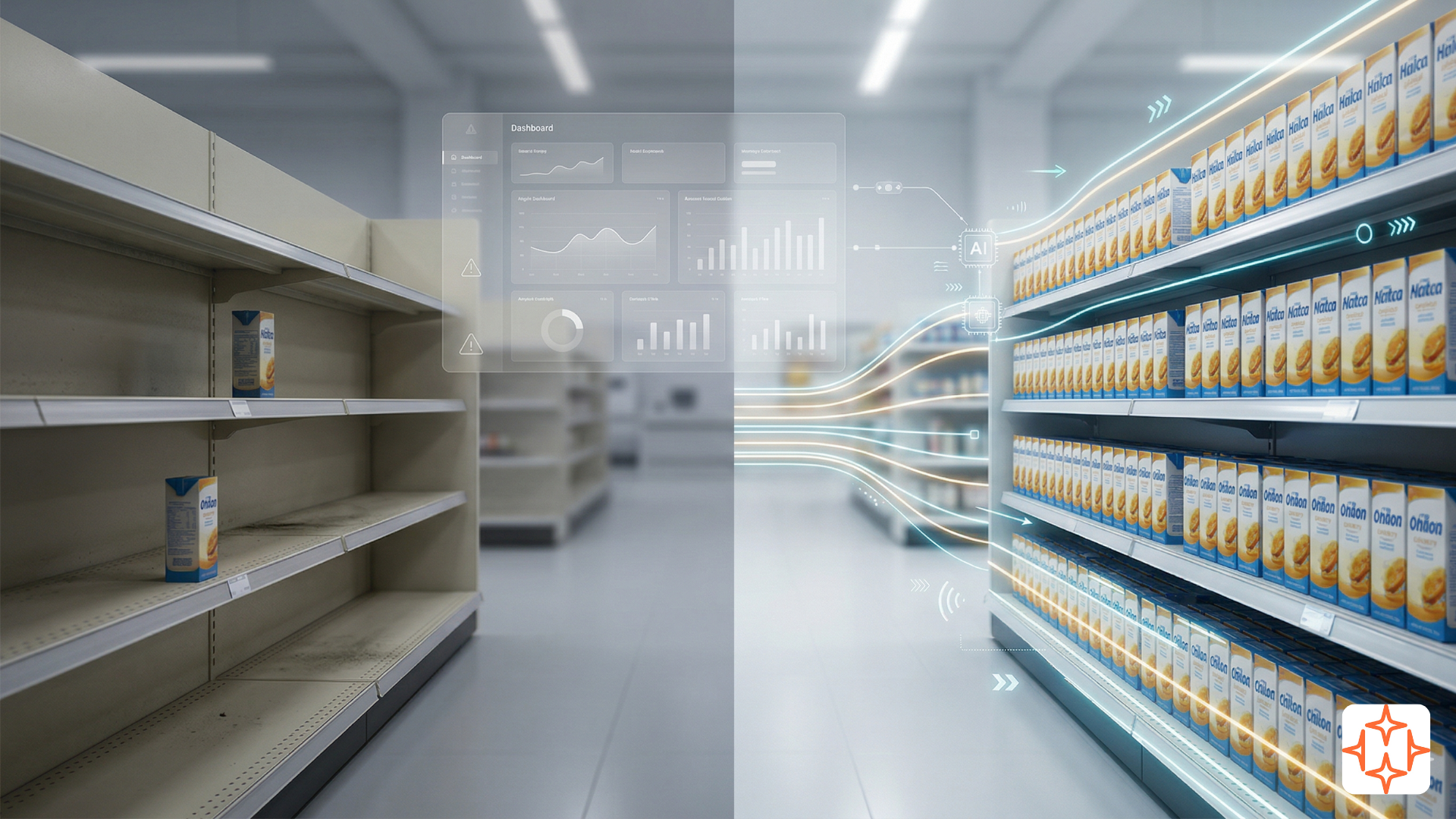
Most modern retailers already operate with inventory management systems.
They can already track inventory across stores, monitor demand patterns in near real time, and forecast stock requirements with reasonable accuracy.
And yet stockouts keep happening, particularly on fast-moving SKUs. The reason is no longer a lack of data. It is the inability to respond fast enough when demand changes.
In practice:
- Demand spikes are detected, but replenishment decisions are delayed
- Inventory exists elsewhere in the network but is not moved in time
- Store teams rely on manual interpretation and coordination
- Replenishment cycles operate slower than real demand
That gap, between detecting demand and correcting inventory, is where revenue is lost.
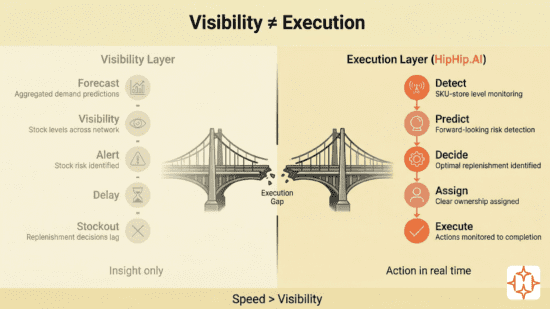
HipHip.AI’s inventory replenishment system is built specifically for this gap. It operates as an execution layer on top of existing retail infrastructure. It does not replace the systems retailers already have. It activates them at the point where they consistently fall short. Where traditional inventory systems stop at insight, HipHip.AI’s inventory replenishment converts that insight into immediate, assigned, and tracked action at the store level.
The difference between planning-layer systems and execution-layer systems becomes clearer when viewed across how they operate in practice.
| Planning-layer inventory systems | Execution-layer replenishment systems | |
| Core function | Forecast demand and optimize allocation | Execute replenishment actions in real time |
| Data usage | Periodic and aggregated | Continuous and SKU and store level |
| Response timing | Batch-based and delayed | Immediate and event-driven |
| Action ownership | Manual and distributed across teams | System-assigned with clear ownership |
| Store-level execution | Inconsistent and dependent on teams | Standardized and system-driven |
| Outcome tracking | Limited visibility into execution | Full tracking from action to completion |
This difference is not just structural. It is where most stockouts actually originate.
 Core capabilities of HipHip.AI’s inventory system
-
Store-level demand intelligence
Most inventory systems forecast demand at an aggregated level.
HipHip.AI’s Store-level demand intelligence operates at the SKU and store level. It continuously recalibrates demand using real-time signals such as sell-through, stockouts, and local demand patterns.
This allows each store to function independently instead of being averaged into network-level forecasts.
What this changes: High-performing stores are no longer understocked, while low-performing stores avoid excess inventory.
-
Initial allocation for new launches
New product launches lack historical data, which makes allocation highly error-prone.
The challenge of allocating new SKUs without historical sales data is one of the most common points where network-level planning tools fall short.
HipHip.AI’s Initial allocation for new launches uses lookalike SKU behavior, store clustering, and early demand signals to distribute inventory intelligently.
What this changes: New products reach the right stores faster. This improves launch performance and reduces imbalance.
-
AI-driven inventory replenishment engine
Replenishment is the most execution-critical capability in retail operations.
HipHip.AI’s AI-driven inventory replenishment engine continuously monitors stock levels, sales velocity, and demand signals at the SKU and store level. It predicts when inventory will run out, identifies the most efficient source of replenishment, and triggers actions automatically. These actions can include warehouse dispatches or inter-store transfers, depending on availability and proximity.
Each replenishment decision is converted into an assigned task with clear ownership and tracked through completion, ensuring that execution does not depend on manual coordination.
What this changes: Stockouts are prevented before they occur. Inventory moves dynamically toward demand instead of remaining static across the network.
-
Special Events and Hot Picks intelligence
Retail demand is not uniform. It is influenced by festivals, promotions, regional preferences, and emerging trends.
HipHip.AI’s Special Events and Hot Picks intelligence detects early demand signals by analyzing changes in sell-through patterns, store-level performance, and category movement. It identifies which SKUs are accelerating faster than expected and adjusts replenishment priorities accordingly.
This allows the system to rebalance inventory across stores before demand peaks fully materialize.
What this changes: Stores respond to demand spikes early. Inventory is positioned ahead of peak demand instead of reacting after stock gaps appear.
-
Smart Filtering and action layer
Most inventory systems provide visibility but rely on teams to interpret data and decide what to act on.
When interpretation is delayed or inconsistent, the impact is not limited to stockouts. Common mistakes that create slow-moving inventory often originate from the same execution gap, where issues are identified but not acted upon in time.
HipHip.AI’s Smart Filtering and action layer removes this dependency by automatically identifying high-impact issues such as stockouts, overstock, and store-level imbalances. It prioritizes these issues based on urgency, demand impact, and revenue potential, and converts them into specific, actionable tasks.
Instead of dashboards requiring interpretation, the system delivers a structured queue of actions with clear ownership and timelines.
What this changes: Decision-making is no longer a bottleneck. Every identified issue translates directly into execution, reducing delays and preventing both stockouts and slow-moving inventory.
-
Inventory Journey Tracking
Inventory issues often originate between planning and store availability, during movement across the network.
HipHip.AI’s Inventory Journey Tracking provides visibility across the full lifecycle of inventory, from warehouse dispatch to store receipt and shelf availability. It tracks movement stages, identifies delays, and highlights breakdowns in the flow of inventory.
This allows retailers to intervene before delays translate into lost sales at the store level.
What this changes: Bottlenecks are detected early. Inventory movement becomes predictable and controllable rather than reactive.
-
Integration layer for ERP, POS, and WMS connectivity
HipHip.AI is designed to operate on top of all existing retail systems.
It integrates with ERP systems for inventory data, POS systems for real-time demand signals, and WMS systems for stock movement. This enables continuous data flow without disrupting existing infrastructure.
The system uses this integrated data to drive execution decisions while allowing retailers to retain their current technology stack.
What this changes: Retailers add an execution layer without undergoing system replacement. Existing investments are activated rather than replaced.
Together, these capabilities operate as a single execution system. Each one feeds into the next, from demand signal to store shelf.
Of these capabilities, replenishment is where execution failures are most costly and most immediate. The next section explains how that engine operates.
How AI inventory replenishment works in practice
AI-driven replenishment systems operate through a continuous loop:
- Real-time signal detection: Sales velocity, stock levels, and demand changes are continuously monitored at the SKU and store level. This ensures that even small shifts in demand are detected early, before they escalate into stock risks. This layer is built on store and SKU-level demand forecasting, which determines how accurately signals are interpreted before replenishment is triggered.
- Stockout prediction: The system calculates how long current inventory will last based on real-time sell-through rates. Instead of reacting to stockouts, it predicts when they are likely to occur and creates a forward-looking view of risk.
- Action generation: Based on predicted stockouts, the system automatically triggers replenishment actions. This can include warehouse dispatches or inter-store transfers, depending on where inventory is available and how quickly it can be moved.
- Task assignment: Each action is assigned to specific store or warehouse teams with clear ownership. This removes ambiguity around who is responsible for execution and ensures that actions are not delayed due to coordination gaps.
- Execution tracking: The system monitors whether the assigned actions are completed within the required timeframe. If execution is delayed or incomplete, it flags the issue and enables intervention before availability is impacted.
In the case of HipHip.AI, this loop operates continuously. It ensures that replenishment decisions move directly from detection to execution without delay.
What this looks like in a real store scenario
A fast-moving SKU begins to accelerate in sales at a high-performing store.
Within minutes, HipHip.AI detects the spike in sell-through and calculates that the store will run out of stock within the next 18 hours. Instead of waiting for manual review, the system triggers a replenishment action and identifies excess inventory at a nearby low-demand store.
A transfer is initiated. Tasks are assigned to the relevant teams. Execution is tracked in real time.
Inventory is replenished before the stockout occurs. Availability is maintained without escalation, coordination delays, or missed demand.
Where HipHip.AI fits in
HipHip.AI operates in the gap between what existing systems recommend and what actually gets done on the shopfloor.
It sits on top of existing systems and ensures that:
- Store-level signals are acted upon immediately
- Replenishment decisions are executed without delay
- Ownership is clearly assigned
- Outcomes are tracked through completion
It does not replace existing systems. It activates them at the point where they fall short.
What it takes to implement AI inventory replenishment
Implementation is phased and designed to work within existing infrastructure.
Typical rollout includes:
- Integration with ERP, POS, and WMS systems
- Mapping of replenishment triggers and thresholds
- Store-level adoption of task-based workflows
- Continuous calibration based on execution patterns
Common challenges include:
- Data inconsistencies across systems
- Transition from manual to automated workflows
- Initial over-triggering of actions
HipHip.AI addresses these through pilot rollouts, calibration loops, and execution tracking. This allows retailers to gradually refine thresholds, align teams with new workflows, and ensure that actions are triggered with the right level of precision.
This phased approach allows teams to transition from manual decision-making to system-driven execution without disrupting existing operations.
Retailers typically begin seeing measurable improvements within 4 to 8 weeks. Full optimization stabilizes within 8 to 12 weeks.
| Also read: How modern retailers are fixing inventory replenishment in 2026 |
The measurable impact of AI-driven replenishment by HipHip.AI
Across multiple retail deployments, including fashion and FMCG networks, HipHip.AI has consistently demonstrated improvements in stock availability, replenishment speed, and inventory utilization at the store level.
- Stockout incidents reduce by 20 to 35 percent within 60 to 90 days
- Sell-through increases by 10 to 20 percent for high-demand SKUs
- Replenishment response time improves by 2 to 3 times
These outcomes are closely tied to tracking infrastructure. How real-time inventory tracking drives store availability explains the visibility layer that enables execution.
The consistent driver across these outcomes is reducing the time between demand detection and replenishment execution.
This becomes even more critical during peak demand periods. Inventory blind spots that compound during festival demand are among the most preventable causes of lost sales when replenishment execution is delayed.
The bottom line
Retail inventory management has solved the visibility problem.
Most retailers now have the data — stock levels, demand patterns, sales velocity — available in near real time. That was the hard problem of the previous decade and it has largely been solved.
The problem that remains is execution.
Data without action doesn’t prevent a stockout. A forecast without follow-through doesn’t move inventory. A replenishment recommendation that waits for manual coordination arrives too late.
This is the gap HipHip.AI is built to close, not by replacing the systems retailers already have, but by activating them at the point where they consistently fall short. From demand intelligence and initial allocation through to replenishment execution, inter-store transfers, event-driven responses, and inventory journey tracking, the system operates as a continuous execution layer across the full inventory workflow.
The advantage in retail is no longer going to the operation with the best visibility.
It is going to the one that acts fastest when demand changes.
Explore how HipHip.AI fits into your current inventory workflows →
Frequently asked questions
What is an AI inventory replenishment system?
An AI inventory replenishment system is designed to continuously monitor demand signals and automatically trigger stock movement actions before inventory issues impact store availability.
Unlike traditional systems that rely on periodic updates or manual intervention, AI-driven systems operate in real time. They analyze sales velocity, stock levels, and demand shifts at the SKU and store level, predict when stockouts are likely to occur, and trigger replenishment or inter-store transfer actions proactively.
These systems also assign tasks to store or warehouse teams and track execution to ensure that actions are completed within the required timeframe. The objective is not just to identify replenishment needs, but to ensure they are executed in time to prevent lost sales.
Why do stockouts happen even when retailers have inventory systems?
Stockouts persist because most inventory systems are designed for planning and visibility, not execution.
They can identify demand changes and highlight stock risks, but they depend on manual interpretation and action at the store level. This introduces delays between detection and response.
Common causes include:
- Delays in acting on demand spikes
- Manual decision-making at the store level
- Inventory available in nearby locations but not transferred in time
- Lack of clear ownership for resolving stock issues
Even with accurate forecasts, if replenishment actions are not executed quickly and consistently, stockouts will continue to occur.
How does AI improve inventory replenishment accuracy?
AI improves replenishment accuracy by continuously recalculating demand and stock requirements using real-time data.
Instead of relying on fixed planning cycles, AI systems detect demand changes as they happen, update stock requirements dynamically, and predict stockout timelines with higher precision.
This allows replenishment actions to be triggered before inventory runs out. The result is not only better forecasting, but better timing and execution of replenishment decisions.
What data is required for AI inventory replenishment?
AI-driven replenishment systems typically require integration with core retail data sources.
These include:
- POS data for real-time sales and transaction patterns
- ERP data for inventory levels, SKU master data, and stock positions
- Warehouse or WMS data for stock movement and dispatch information
In addition, execution-layer systems rely on:
- Store-level stock signals
- Sell-through velocity
- Replenishment cycle timing
The quality and consistency of this data directly impact system performance. Clean and well-integrated data enables more accurate predictions and faster execution.
How long does it take to implement an AI replenishment system?
Implementation timelines vary depending on the size of the retail network and the readiness of data systems.
In most cases:
- Initial integration and pilot rollout take 4 to 8 weeks
- Measurable improvements begin within 60 to 90 days
- Full optimization stabilizes within 8 to 12 weeks
A phased rollout approach allows retailers to validate results at a smaller scale before expanding across all stores.
What ROI can retailers expect from AI inventory replenishment?
Retailers adopting execution-driven replenishment systems typically see measurable improvements across key metrics.
These include:
- 20 to 35 percent reduction in stockout incidents
- 10 to 20 percent increase in sell-through for high-demand SKUs
- 2 to 3 times faster replenishment response
These improvements are driven by reducing the delay between demand detection and replenishment execution. Faster response leads to higher availability and better inventory utilization.
How do AI systems handle seasonal demand spikes and regional trends?
AI-driven replenishment systems are designed to respond to demand variability caused by festivals, promotions, and regional trends.
They continuously monitor changes in sales velocity and store-level demand patterns. When a spike is detected, the system adjusts replenishment frequency, prioritizes high-demand SKUs, and redistributes inventory across stores.
This enables retailers to respond proactively to peak demand periods instead of reacting after stock gaps have already occurred.
What is the difference between Inventory management and Inventory replenishment?
Inventory management and inventory replenishment operate at different layers of retail operations: visibility and execution.
Inventory management functions as the visibility layer. It provides a complete view of stock across stores and warehouses, tracks inventory levels, and forecasts demand. It helps retailers understand what is happening across the network, but it does not ensure that actions are taken in time.
Inventory replenishment functions as the execution layer. It acts on those insights by triggering stock movement—such as warehouse dispatches or inter-store transfers—to ensure products are available where demand exists. It focuses on what needs to be done next and ensures that it is completed without delay.
The core difference:
- Inventory management tells you where the problem is
- Inventory replenishment ensures the problem is resolved in time
In many retail systems, this gap between visibility and execution is where stockouts occur. Modern AI-driven replenishment systems are designed to close this gap by converting demand signals directly into real-time, trackable actions.