


How a connected helpdesk stops unresolved retail issues from turning into business breakdowns

Across retail operations, stores and teams generate signals constantly. A checklist item is missed. A campaign is not executed on time. A store runs out of a key SKU. A compliance check fails. These signals get flagged.
After they are flagged:
- Some get picked up and resolved
- Some get passed across teams without clear ownership
- Some remain visible but do not lead to action
When issues move without clear ownership, store teams spend time coordinating rather than executing. Follow-ups replace floor presence. Staff are mentally occupied with what is unresolved rather than what is in front of them. At the store level, this affects how customers are served. Across a network of hundreds of stores, it affects how reliably the business executes against its targets.
Retail operations need a way to convert these signals into trackable issues, assign ownership, and move them to resolution. That is the role the helpdesk plays.
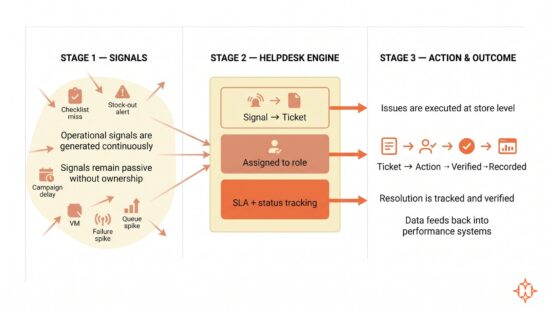
How HipHip.ai’s helpdesk connects across retail operations
HipHip.ai’s helpdesk acts as the execution layer across retail operations:
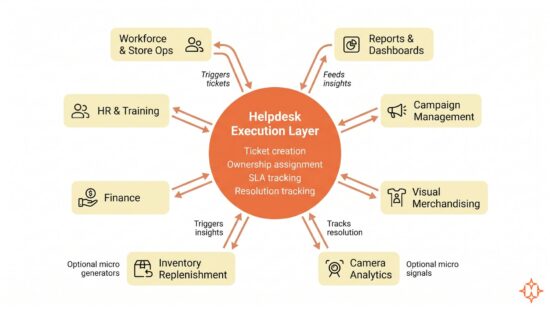
-
Workforce & store ops
When a task is missed and there is no system to catch it, store teams end up coordinating the gap manually, tracking what is pending, following up across functions, chasing confirmation. That time comes directly off the floor.
Daily checklists define execution at the store level. When a checklist item is missed or failed, HipHip converts it into a helpdesk ticket with the task, store, and responsible role attached. The ticket is assigned, tracked, and feeds into store performance scoring once resolved.
How it works:
- Missed checklist → Auto-ticket
- SLA breach → Escalation
- Closed ticket → Performance score
- Score → Incentive payout
Use Case:
At Store 3, a safety check is marked incomplete due to a broken exit latch. A high-priority helpdesk ticket is created and assigned to the store manager and facilities team with a 2-hour SLA. The latch is repaired, and the ticket is closed with proof. The missed task becomes a tracked safety issue with a clear resolution record.
Ticket:
- Triggered by: Ops checklist · Item marked incomplete
- Priority: High, Safety
- Assigned to: Store Manager + Facilities Team
- SLA: 2 hrs · Met · Latch repaired
Outcome: Checklist gaps are converted into accountable actions and reflected in store performance.
-
Reports & dashboards
A score drop in a dashboard is only useful if someone acts on it. Without a defined path from insight to action, performance data gets reviewed in calls, noted, and followed up on manually. By the time the root cause is identified, the same issue has often repeated across multiple stores.
Reports highlight performance gaps. HipHip connects these gaps to the helpdesk by raising review tickets when thresholds are breached. The ticket assigns ownership for investigation and corrective action.
How it works:
- Score drop → Review ticket
- Recurring issue → Pattern alert
- Ticket data → Dashboard metrics
Use Case
Store 14’s execution score drops from 84 to 61. A helpdesk ticket is raised to the cluster manager. The manager identifies recurring checklist failures and assigns corrective actions. The performance drop leads directly to investigation and action.
Ticket:
- Triggered by: Dashboard anomaly · Score threshold breach
- Assigned to: Cluster Manager
- Root cause: Recurring checklist failures
- Action: Corrective plan assigned
Outcome: Performance data leads to structured action with clear ownership.
-
In-store campaign management
A campaign that does not execute on time does not recover lost ground. The window is fixed, the spend has gone out, and a store that misses activation contributes nothing to the campaign’s return. When this happens across multiple stores without immediate visibility, the gap is usually identified after the campaign has closed.
When a store misses a milestone such as POSM confirmation or activation, HipHip raises a helpdesk ticket with the campaign, store, and task context attached. The ticket is assigned to the relevant area manager, ensuring the gap is owned and resolved within a defined timeline.
How it works:
- Missed activation → Ticket
- POSM delay → Escalation
- Compliance gap → Routed to AM
Use Case
A national summer promotion goes live Monday. By Tuesday afternoon, HipHip’s campaign module shows Stores 4 and 17 have not confirmed POSM placement. Two helpdesk tickets are raised, one per store, assigned to the respective area managers with a 24-hour SLA. Store 4 confirms placement by evening. Store 17’s ticket breaches SLA and escalates to the cluster head. The system captures where the delay happened, how long it lasted, and who resolved it.
Ticket:
- Triggered by: Campaign compliance module · Day 2 check
- Assigned to: Area Manager, Zone 3
- SLA: 24 hrs · Breached · Auto-escalated to Cluster Head
- Status: Cluster Head notified · Awaiting store confirmation
Outcome: Execution gaps are not left for review calls. They are tracked, owned, and escalated within the campaign window.
-
Visual merchandising
A non-compliant store does not always look wrong to the people inside it. Without a system that catches and corrects VM issues within the same cycle, stores operate with incorrect displays for days. At scale, that means the brand is being presented inconsistently across the network for the duration of the gap.
When HipHip detects a non-compliant store image, it raises a helpdesk ticket with the submitted photo, reference guideline, and violation details attached. The ticket is assigned to the store’s VM owner, ensuring correction is tracked to closure.
How it works:
- AI photo fail → Auto-ticket
- Photo + guideline attached
- Re-submission closes ticket
Use Case:
A store manager submits a VM photo for the denim wall. The AI flags a non-compliance: incorrect colour sequence and misplaced hero SKU. A helpdesk ticket is raised with the photo and reference planogram, assigned to the VM lead with a 48-hour SLA. The VM lead corrects the display, submits a new photo, and closes the ticket. The issue is identified, corrected, and verified within the same cycle.
Ticket:
- Triggered by: AI photo compliance check · Score: 41/100
- Violation: Colour sequence reversed · Hero SKU misplaced
- Assigned to: VM Lead, Store 11
- SLA: 48 hrs · Correction + re-submission required
Outcome: Compliance issues are corrected in real time, with a clear record of what was wrong and how it was fixed.
-
Camera analytics
A billing queue that builds without response does not just slow down a transaction. It affects how many customers complete a purchase and how they leave the store. At peak hours, every minute of delay has a direct cost to conversion.
When thresholds are breached, such as long billing queues, HipHip raises a helpdesk ticket for immediate action. The ticket is assigned to the floor supervisor and tracks response time.
How it works:
- Queue spike → Live ticket
- Unattended zone → Floor alert
- Response logged + timed
Use Case:
At 3:40 PM on a Saturday, Store 6 sees 8 customers in the billing queue with only one counter open. A helpdesk ticket is raised and assigned to the floor supervisor. A second counter is opened within 4 minutes, and the ticket is closed with a response log. The event is captured with timing and action taken.
Ticket:
- Triggered by: Camera analytics · Queue length: 8 (threshold: 5)
- Assigned to: Floor Supervisor, Store 6
- Response time: 4 mins · Second counter opened
- Logged for: Weekly ops review · Staffing pattern analysis
Outcome: Real-time signals lead to immediate action, with measurable response time.
-
Inventory replenishment
A stockout on a top-selling SKU over a weekend is not recovered on Monday. The sale is gone, and depending on the category, so is the customer visit. When replenishment alerts sit as passive dashboard flags, the gap between flagging and action depends entirely on whether someone checks the dashboard in time.
When HipHip’s replenishment engine flags a stockout, overstock, or aging SKU, it does not stay as a dashboard alert. A helpdesk ticket is automatically created, categorised, prioritised, and assigned to the store manager or supply chain owner responsible for action. The ticket carries the SKU, store, and alert context, so the issue can be acted on immediately.
How it works:
- Stockout → Auto-ticket
- SLA on replenishment action
- Closed ticket updates stock record
Use Case:
Store 9’s top-selling SKU drops below the reorder threshold on a Friday afternoon. The replenishment module flags it. Instead of a passive dashboard alert that may or may not be seen over the weekend, a helpdesk ticket is automatically created and assigned to the store manager with a 4-hour SLA. The manager acknowledges, raises the transfer request within the app, and closes the ticket. On Monday morning, the regional ops head sees: flagged Friday, resolved Friday, stock transferred Saturday. No weekend stockout. Full audit trail.
Ticket:
- Triggered by: Replenishment engine · Auto-raised
- Assigned to: Store Manager, Store 9
- SLA: 4 hrs · Met · Resolved in 2h 40m
- Action taken: Inter-store transfer raised · Stock confirmed Saturday AM
Outcome: The issue didn’t wait for a review cycle to surface. It was raised, owned, and resolved before it became a stockout.
-
Finance
Financial exceptions that move through informal channels create approval delays and incomplete audit trails. When the same exception recurs without a structured record, it is difficult to identify whether it reflects a one-time situation or a pattern that needs a policy response.
When a transaction exceeds limits or fails validation, HipHip raises a helpdesk ticket with the relevant data and documents attached. The ticket routes to the appropriate approver and records the decision.
How it works:
- Budget breach → Approval ticket
- Invoice error → Finance ticket
- Approval trail recorded
Use Case: Petty Cash Exception
Store 8 submits a ₹4,200 expense exceeding the limit. A helpdesk ticket is raised to the area manager with invoice details. The manager reviews and approves. Finance processes the reimbursement. The decision is recorded with full context.
Ticket:
- Triggered by: Spend management · Limit breach
- Assigned to: Area Manager
- Decision: Approved
- Audit trail: Invoice + approval note
Outcome: Every financial exception has clear ownership and a documented decision.
-
HR & training
A recurring issue across stores is usually not a coincidence. When the same type of failure keeps appearing, it points to a gap in how a process was taught or understood. Without visibility into patterns, the response tends to be reactive, addressing the instance rather than the cause.
HipHip identifies patterns in helpdesk tickets and raises training tickets for intervention. The assigned training is tracked, and its impact is visible through reduced issue recurrence.
How it works:
- Recurring issue → Training ticket
- L&D module assigned
- Completion tracked → Issue reduction
Use Case: Recurring VM Failures
Store 2 has repeated VM compliance issues. A training ticket is raised to L&D. A module is assigned and completed. Over the next few weeks, the issue does not recur. The pattern leads to targeted training and measurable improvement.
Ticket:
- Triggered by: Helpdesk pattern · Repeated VM issues
- Assigned to: L&D Manager
- Action: Training module assigned
- Outcome: Issue reduction
Outcome: Recurring issues are converted into structured training interventions.
What this actually changes in retail operations
| Operational Area | What Changes |
| Issue capture | A missed task or operational gap immediately becomes a tracked issue, without relying on someone to raise and follow up manually |
| Ownership | Every issue is assigned to a specific role, removing ambiguity on who is responsible for resolution |
| Escalations | Issues are resolved at the store or function level before moving up, reducing dependency on escalation chains |
| Pattern visibility | Repeated issues across stores become visible as patterns, enabling root cause fixes instead of repeated handling |
| Performance linkage | Resolution timelines and outcomes are recorded, making execution measurable and linked to performance |
At the scale of hundreds of stores, the difference between issues that get resolved and issues that get lost shows up in how consistently the business executes. Across stores running on HipHip.ai:
- 40% fewer escalations (Platform-wide)
- 95%+ execution consistency (Platform-wide)
- 90% VM compliance
- 40% fewer incentive disputes
Closing Thoughts
At a small scale, issues can be managed through follow-ups, calls, and manual tracking. As the number of stores, teams, and functions increases, that approach breaks down. Issues move across people, ownership becomes unclear, and patterns are harder to see.
A connected helpdesk brings structure to this. Every issue follows a defined path, from the moment it is triggered to the point it is resolved and recorded. That consistency is what allows operations to scale without losing control.
About HipHip.AI
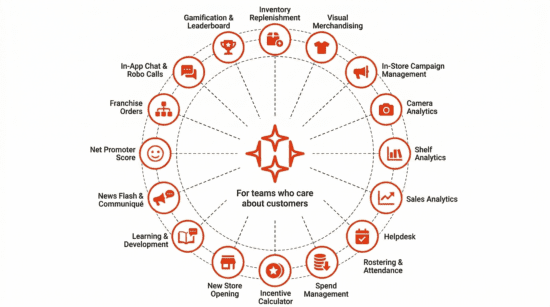
HipHip.AI is an AI-powered, end-to-end retail execution platform used across 10,000+ retail brick and mortar stores. It unifies inventory, merchandising, campaign management, store teams, and store spend into a single operating system—enabling real-time visibility and execution across stores.
Core capabilities include:
- Inventory Replenishment
- Visual Merchandising
- In-Store Campaign Management
- Camera Analytics
- Shelf Analytics
- Sales Analytics
- Helpdesk
- Task Manager
- Rostering & Attendance
- Spend Management
- Incentive Calculator
- New Store Opening
- Learning & Development
- News Flash & Communiqué
- Net Promoter Score
- Franchise Orders
- In-App Chat & Robo Calls
- Gamification & Leaderboard
HipHip.AI integrates seamlessly with existing POS, ERP, WMS, and HRMS systems, ensuring zero disruption to current infrastructure while unlocking smarter, faster retail execution.
Talk to an expert → hiphip.ai
Frequently asked questions
- What makes HipHip’s helpdesk different from a standalone ticketing tool?
Most ticketing tools require someone to manually raise an issue, assign it, and follow up. They sit outside the systems where execution actually happens, which means the gap between a signal and a ticket depends entirely on whether someone noticed and acted.
HipHip’s helpdesk sits across every retail function. When a checklist item is missed, a campaign milestone is skipped, a VM photo fails compliance, or a stockout is flagged, a ticket is automatically created with the store, role, and context already attached. No manual raising, no coordination to get it into the system. The issue moves from signal to owned action without depending on human intervention at the point of capture.
- If execution is already tracked through checklists and reports, why is a helpdesk needed?
Checklists and reports capture what happened, but they do not ensure that issues move forward. A missed task remains a record, and a compliance gap remains visible in a dashboard until someone takes ownership. In most cases, follow-up depends on manual intervention. At scale, that dependency compounds. The same gaps keep appearing because there is no system ensuring they were actually closed.
HipHip’s helpdesk converts these gaps into structured issues with assigned ownership, defined SLAs, and a tracked path to resolution. That is what turns tracking into execution.
- Where does the helpdesk actually fit within retail operations?
Checklists and reports capture what happened, but they do not ensure that issues move forward. A missed task remains a record, and a compliance gap remains visible in a dashboard until someone takes ownership. In most cases, follow-up depends on manual intervention. At scale, that dependency compounds. The same gaps keep appearing because there is no system ensuring they were actually closed.
HipHip’s helpdesk converts these gaps into structured issues with assigned ownership, defined SLAs, and a tracked path to resolution. That is what turns tracking into execution.
- How does the helpdesk reduce escalations without adding another layer of complexity?
Escalations typically happen when issues are not resolved early or when ownership is unclear. In the absence of a structured system, issues move across teams without clear accountability, which leads to delays and repeated follow-ups. Over time, escalation becomes the default path rather than the exception.
HipHip’s helpdesk assigns issues at the right level with defined timelines, so most of them are resolved before they need to move up the chain. The structure replaces the follow-up chain, not adds to it.
- How does this change the role of store managers and area managers?
In most retail setups, store managers and area managers spend a significant portion of their time coordinating issues, following up with different teams, and ensuring that something gets resolved. That time is not going into execution, it is going into managing the absence of a system.
With HipHip’s helpdesk, ownership is defined and progress is tracked from the moment an issue is raised. This frees both roles to focus on resolution and floor execution rather than coordination.
- What makes the helpdesk central to performance and incentives?
Performance in retail is often measured through outcomes such as sales or checklist completion, but the quality of execution behind those outcomes is not always visible. A store can show green on a dashboard while unresolved issues are quietly affecting how the floor operates.
HipHip’s helpdesk captures how issues are handled across every function, including resolution timelines, SLA adherence, and repeat occurrences. This gives leadership a reliable record of execution quality, not just outcomes, which feeds directly into performance scoring and incentive calculations.