


You have real-time inventory. Why are stores still out of stock?

Most large retailers today operate with continuous inventory visibility across stores and warehouses. Stock positions are no longer the constraint.
Yet availability at the store level remains inconsistent.
The breakdown begins when inventory is treated as a static position instead of a moving system. Store demand shifts faster than allocation logic, replenishment follows fixed cycles, and decisions are made on snapshots that are already outdated by the time they are used.
As a result, inventory exists in the network, but not where and when it is required. Retailers lose an estimated $1.7 trillion globally each year due to inventory distortion, driven by a combination of stockouts and overstocks.
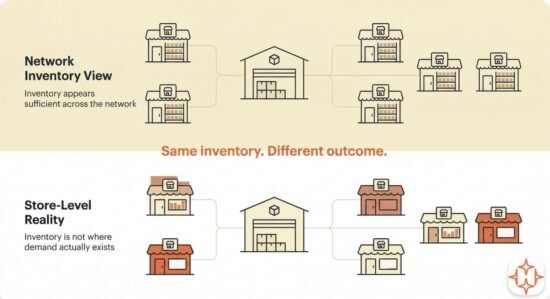
Why stockouts persist despite high inventory
In most retail networks, inventory decisions are still governed by fixed planning and replenishment cycles, while store-level demand evolves continuously.
This creates a timing mismatch.
In many retail networks, up to 30–50% of inventory is misallocated across locations, meaning stock exists within the system but not where demand is actually occurring.
Allocation is based on historical consumption patterns, and replenishment follows predefined intervals. In the time between these cycles, demand shifts at the store level, but the system does not adjust in step.
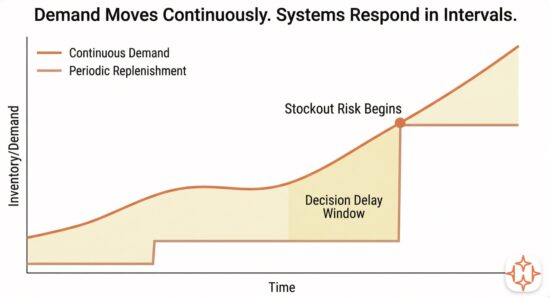
At the store level, this misalignment typically presents as:
- inventory building up in locations where sell-through has slowed
- high-velocity SKUs depleting faster than replenishment cycles can respond
- corrective actions being triggered only after availability has already been impacted
The issue is not overall inventory sufficiency. It is the inability of the operating model to respond to demand changes at the required pace.
As a result, inventory remains within acceptable limits at the network level, while store-level availability continues to break.
Visibility doesn’t guarantee availability
This timing mismatch is reinforced by how inventory systems are structured.
Decisions are driven by periodic snapshots, while demand continues to shift between those points. The system reflects inventory positions, but does not keep pace with how those positions are changing at the store level.
In practice:
- allocation continues to follow historical patterns
- replenishment adheres to fixed cycles
- adjustments are triggered after deviations become visible
This creates a consistent delay between what is happening on the ground and how the system responds.
As a result, inventory remains visible across the network, but availability at the store level continues to lag behind demand.
The difference between these two approaches becomes clearer when viewed side by side:
| Aspect | Static Inventory View | Real-Time Movement View |
| Basis | Current stock position | How stock is changing |
| Decision trigger | Periodic review | Continuous signals |
| Demand view | Historical | Current velocity |
| Response timing | After deviation | During deviation |
| Store-level accuracy | Limited | High |
| Outcome | Reactive adjustments | Timely intervention |
What real-time tracking actually reveals
Real-time inventory tracking brings visibility into how inventory is changing at the store level, not just where it stands.
It captures:
- sales velocity at the SKU level
- rate of inventory depletion
- variation in demand across stores (which often becomes visible only when demand is captured at a true store-SKU level)
- impact of promotions and local factors
This level of granularity surfaces demand shifts as they happen, rather than after they are reflected in periodic reports.
How real-time tracking improves availability
When these signals are acted upon in time, availability begins to improve.
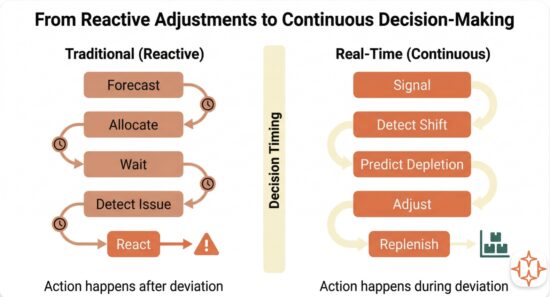
Instead of waiting for periodic reviews, teams can move toward replenishment that adapts in real time to demand shifts.
This allows:
- early identification of SKUs with accelerating demand
- estimation of short-term depletion based on current velocity
- prioritization of stores where availability risk is highest
- timely replenishment before stock levels fall below demand
Decisions align more closely with current demand conditions, reducing the delay between demand change and system response.
This difference becomes clearer in a typical scenario:
A fast-moving SKU begins to accelerate in a few stores due to local demand. In a periodic system, this is reflected only after depletion. With continuous tracking, the acceleration is visible early, allowing replenishment to be adjusted before stock runs out.
The business impact:
Improved responsiveness at the store level directly changes how inventory performs across the network.
- higher on-shelf availability for high-demand SKUs
- better alignment between inventory placement and actual demand
- reduced lost sales from stockouts in high-velocity locations
- more efficient use of working capital tied up in inventory
Availability becomes more consistent without requiring higher overall inventory levels.
Even small improvements in availability can drive 2–5% sales uplift, while better inventory allocation can reduce working capital tied up in stock by 10–20%.
Risks in moving to real-time systems
Shifting to real-time systems requires more than faster data. It demands consistency in inputs and clarity in decision-making.
When data across systems is not aligned, faster decisions can amplify errors. At the same time, shorter decision cycles require stronger coordination between planning and execution.
In practice, this shows up as:
- inconsistent data across sources
- misalignment between teams
- reacting to signals without clear prioritization
Real-time systems improve responsiveness, but they also require tighter control.
Where HipHip.AI fits
Acting on inventory signals in time requires a system that can evaluate demand, stock levels, and replenishment constraints together, at the level where availability is decided.
HipHip.AI operates within this decision layer, working directly on SKU and store-level inputs. It continuously evaluates how inventory is moving, how quickly it is expected to deplete, and how supply timelines compare to that movement.
In practice:
- inventory movement is assessed continuously, not at fixed intervals
- availability risk is identified before it becomes visible at the store
- decisions are aligned to current demand conditions, not past patterns
This keeps inventory decisions in step with how demand is evolving, reducing the gap between signal and response at the store level.
This effectively removes the delay between how inventory is moving and how decisions are made.
Closing thoughts
Most retail systems today can report inventory with a high degree of accuracy. That is no longer where the challenge lies.
The breakdown happens in how quickly decisions adapt to what is changing at the store level. Demand shifts continuously, while most systems and processes still operate in intervals. The gap between the two is where availability is lost.
Closing that gap depends on how quickly decisions adapt to changing demand and inventory movement.
When that alignment is achieved, availability becomes more stable, not because inventory increases, but because it is positioned and replenished in line with actual demand conditions.
Frequently asked questions
Why do retail stores face frequent stockouts despite high inventory levels?
Stockouts often occur due to uneven inventory distribution across stores. While total inventory may be sufficient at the network level, it may not be available where demand actually exists. Variations in local demand, delayed replenishment, and lack of store-level visibility into movement contribute to this gap.
Why does ERP-based inventory visibility fail at the store level?
ERP systems are designed for aggregated reporting and periodic planning. They typically lack SKU-level, store-specific granularity and do not track real-time inventory movement. As a result, they provide a static view of inventory without capturing how quickly stock is depleting or how demand is changing at individual stores.
What are the hidden inventory risks in large retail chains?
Large retail networks often face risks that are not visible in aggregated reports, such as:
- stock existing in the system but not at the required store
- imbalance across locations
- slow-moving inventory masking shortages of fast-moving items
- delayed response to sudden demand changes
These issues directly impact store-level availability.
How can retailers identify demand-supply mismatch at a granular level?
Demand-supply mismatch can be identified by analyzing inventory at the SKU × store × time level. This involves tracking sales velocity, stock cover, and lead times. When demand grows faster than replenishment or stock cover drops below lead time, it indicates a potential mismatch that needs attention.
What is the difference between real-time inventory tracking and traditional ERP systems?
Real-time inventory tracking focuses on continuous data updates and movement analysis at a granular level. It captures how inventory behaves across stores. In contrast, ERP systems rely on periodic updates and provide a broader, aggregated view of inventory, often missing store-level dynamics and short-term demand shifts.
What data is required for real-time inventory tracking in retail?
Effective real-time tracking depends on combining multiple data sources, including:
- SKU-level sales data
- store-level inventory
- warehouse stock availability
- lead times and supply constraints
- contextual demand signals such as promotions
The value comes from integrating and interpreting this data continuously.
What is the ROI of real-time inventory tracking systems in retail?
Real-time inventory tracking improves availability, which directly impacts revenue. Benefits include better in-stock rates, reduced lost sales, improved inventory utilization, and more efficient replenishment. These outcomes contribute to both higher sales and better operational efficiency.
What are the risks involved in transitioning from batch to real-time systems?
Transitioning to real-time systems can introduce challenges such as:
- inconsistent or fragmented data across systems
- complexity in system integration
- the need for faster, more responsive decision-making processes
There is also a risk of acting on data without proper interpretation, which can lead to incorrect decisions if not managed carefully.