


How to Ensure VM Compliance Across Stores Using AI
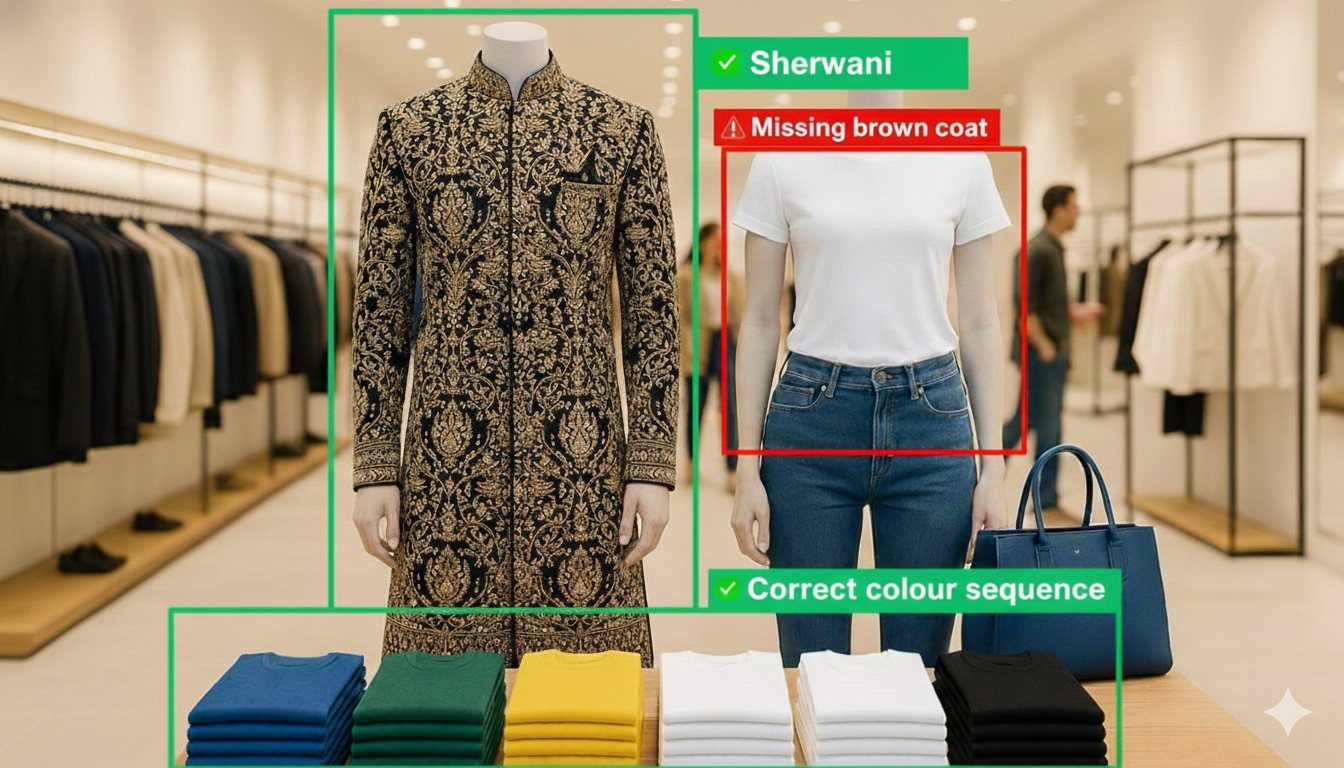
For most retail leaders, Visual Merchandising compliance breaks for a simple reason: scale.
What works across 10 stores starts breaking at 50.
What looks manageable at 100 stores becomes chaotic at 300.
And beyond that, VM compliance turns into a constant cycle of audits, escalations, and follow-ups.
Despite detailed guidelines, structured checklists, and regular audits, brands still struggle to answer one basic question:
Are our stores actually executing VM the way we intended, right now?
This is where AI is starting to play a meaningful role. But not in the way most people think.
Why VM compliance breaks at scale
Before talking about AI, it’s important to understand why traditional VM compliance methods fail as store networks grow.
1. VM is visual and subjective
Unlike pricing or inventory, VM is not binary.
Two stores can “follow the checklist” and still look completely different.
2. Manual audits are reactive
Audits happen after execution, often days later.
By the time issues are spotted, customers have already experienced them.
3. Store teams work under real constraints
Staff rotation, peak hours, missing props, and format differences all introduce variability that static guidelines cannot handle.
4. Managers end up chasing instead of improving
WhatsApp photo requests, calls, and escalation loops consume time but rarely improve execution quality.
The result is predictable:
- high audit effort,
- frequent escalations,
- inconsistent brand experience.
What “AI-led VM compliance” actually means
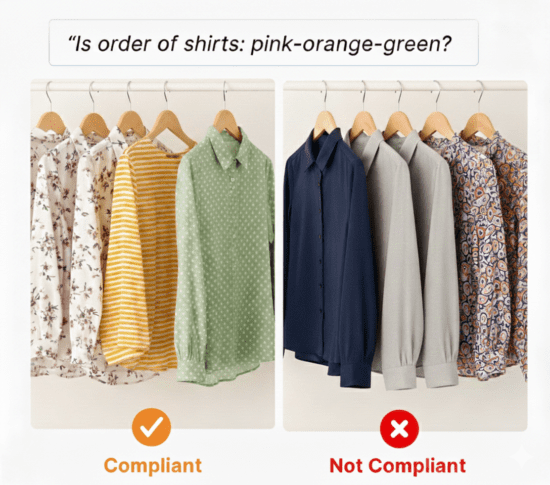
Many solutions talk about AI, but from a retail execution lens, AI-led VM compliance should do three things:
- Validate execution objectively, not just record it
- Reduce dependency on manual audits, not add another layer
- Improve store-level execution, not just create dashboards
AI is not valuable because it “detects issues”. It is valuable only if it changes how VM is executed on the shop floor.
The three layers required to ensure VM compliance at scale
From working with large retail networks, one pattern is clear:
AI works best for VM compliance when it is part of a closed-loop execution system, not a standalone audit tool.
Layer 1: Guide execution before mistakes happen
Most VM failures happen because store teams are unclear about what “right” looks like.
AI alone cannot fix this.
What works is image-led guidance:
- clear visual references for each VM task,
- store-type and campaign-specific examples,
- removing interpretation from execution.
This shifts VM from “read and interpret” to “see and match”. Instead of using AI only to check compliance, HipHip uses visuals to prevent non-compliance in the first place.
Layer 2: Validate execution in real time using AI
Once execution happens, AI becomes powerful.
With AI-led photo validation:
- store teams upload photo proof,
- AI checks alignment against VM guidelines,
- compliance is scored instantly,
- thresholds and tolerances are configurable.
This replaces delayed audits with immediate validation.
At HipHip, this means:
- instant compliance checks,
- spot checks where required,
- exception alerts instead of blanket reviews.
Compliance is verified at the moment of execution, not discovered later.
Layer 3: Act only on exceptions, not on everything
The biggest operational mistake brands make is trying to manage every store equally.
AI enables a better approach: exception-first management.
Instead of reviewing every store:
- managers see only non-compliant or at-risk stores,
- drilldowns include visual proof and reason codes,
- corrective action is focused and faster.
This is how brands using HipHip reduce:
- manual audits by ~40%,
- VM escalations by ~50%,
- without lowering standards.
How HipHip ensures VM compliance differently
HipHip ensures VM compliance by combining the below three things:
- Image-led VM guidance
Store teams see exactly what to execute, not just what to check. - AI-led photo validation
Execution is validated instantly against guidelines, with configurable thresholds. - Exception-based operations
Managers act only where intervention is needed, across regions and campaigns.
On top of this, HipHip.Ai adds:
- role-based dashboards (store manager, head of VM, head of retail),
- visual proof repositories for audits and reviews,
- staff feedback loops that improve execution over time.
The result is not tighter policing.
The result is calmer, more predictable VM operations at scale.
What changes when VM compliance is done right
Retail brands that move to AI-led, execution-first VM compliance typically see:
- Consistent VM across stores, even during campaigns
- Faster rollouts with fewer surprises
- Reduced audit fatigue
- Fewer escalations and follow-up loops
- Higher confidence among store teams
Most importantly, VM stops being a recurring firefight and becomes a controllable process.
Frequently Asked Questions
Can AI replace VM audits completely?
AI significantly reduces the need for routine audits. Audits shift from being the default to being exception-based, focused only where AI flags issues.
Does AI work across different store formats?
Yes, when guidelines, thresholds, and visual references are designed by store type. HipHip supports format-specific VM logic.
What about poor lighting or partial visibility in photos?
AI validation is supported by configurable confidence thresholds and human review where needed. Edge cases are handled through exception workflows, not ignored.
Is this only for large enterprise retailers?
AI-led VM compliance delivers the most value where scale introduces complexity, typically mid-size to large retail networks.
How is AI-led VM compliance different from traditional checklist tools?
Traditional checklist tools track task completion. AI-led VM compliance validates execution quality. The focus shifts from “Was the task done?” to “Was the task done correctly, as intended by the brand?”
How does HipHip handle campaign-specific VM changes?
HipHip supports campaign-specific VM workflows with visual references tied to the campaign. AI validation adapts to campaign guidelines, helping stores execute faster and more consistently during time-bound rollouts.
What kind of visibility does head office get with HipHip?
Head office teams get real-time, role-based visibility into VM compliance across regions, stores, campaigns, and formats, supported by visual proof and drill-downs rather than summary scores alone.
Ensuring VM compliance across stores is not about more audits or stricter checklists.
It is about guiding execution clearly, validating it early, and acting only where it breaks. AI makes this possible, but only when it is designed around real store behavior, not just image detection.
That is the shift HipHip.Ai enables, helping retail brands move from manual enforcement to consistent, scalable VM compliance.