


Retail’s blind spot: Why sales are lost before shelves go empty
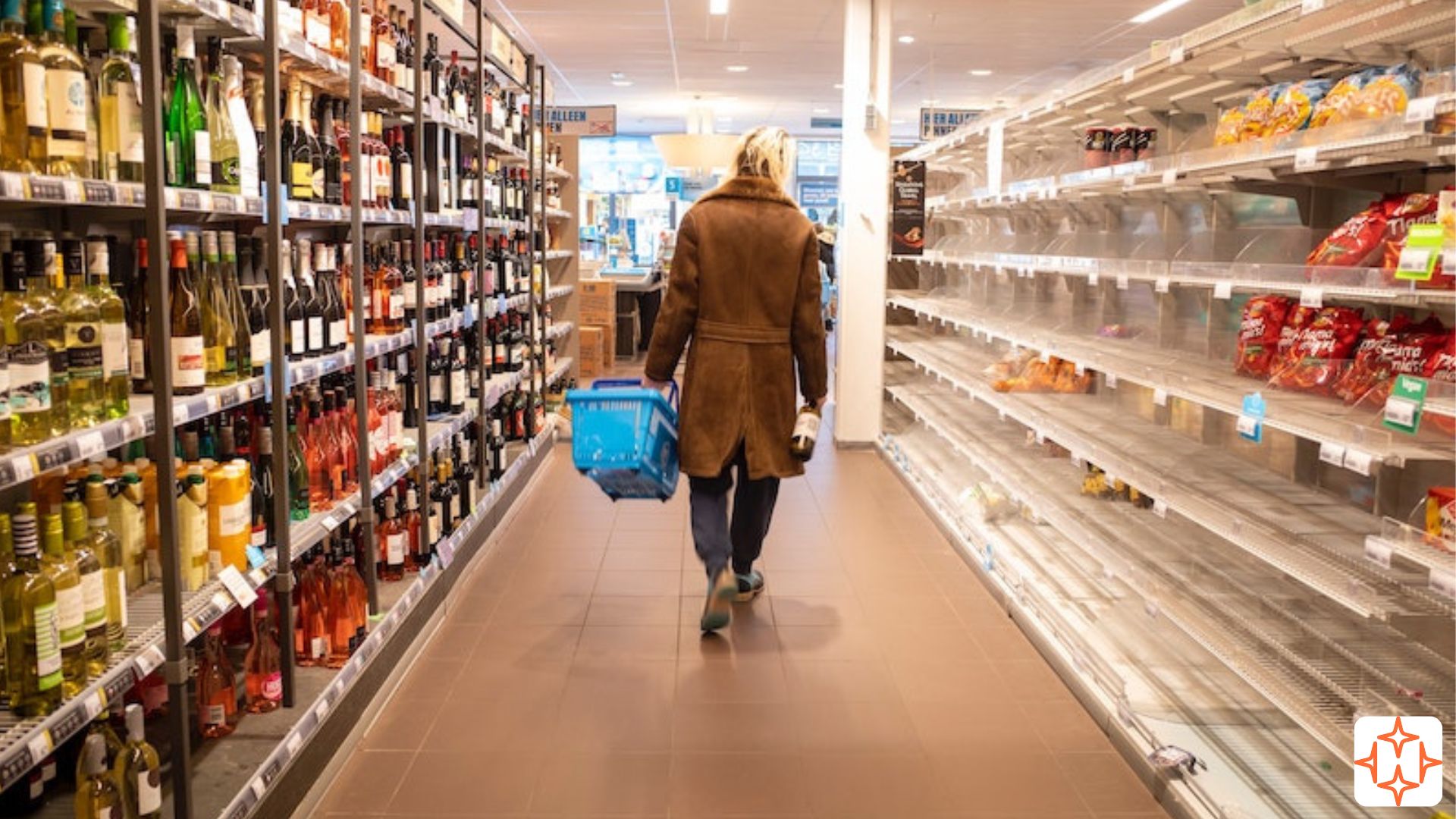
Inventory replenishment is rarely a planning problem. In most retail networks, assortment planning, reorder logic, and warehouse availability are already in place.
Yet shelves still go empty.
Replenishment breakdowns rarely start at the warehouse. They start at the moment a shelf begins to drift out of sync with demand. In many cases, inventory exists in the system but is already unavailable to the customer.
Across formats such as grocery, convenience, pharmacy, electronics, and fashion, replenishment misses are most often caused not by stock unavailability, but by missed visibility at the store level.
Based on our experience working with numerous retail brands across categories, a large share of replenishment failures begin with a simple issue: staff did not notice the shelf emptying early enough.
Reality of high-velocity shelves
High-velocity SKUs behave differently from slow movers.
They experience:
- Faster depletion
- Higher customer interaction
- Greater visual disruption
In many retail chains:
- 30–50% of daily replenishment misses originate from the top 10–15% of SKUs
- These SKUs are often located in high-traffic zones where disruption happens rapidly
- Shelves can move from “acceptable” to “broken” within 30–90 minutes
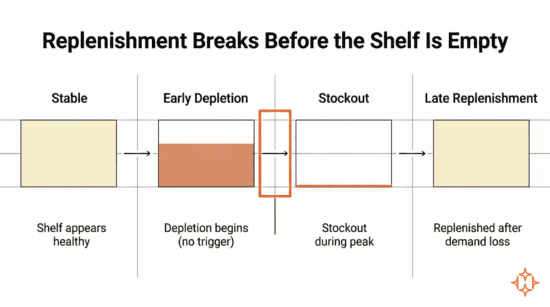
From a store manager’s perspective, the shelf was “fine earlier”.
From a customer’s perspective, the shelf is already empty.
In high-footfall stores, peak-hour demand can drive over 40% of daily SKU movement within a 2–3 hour window, compressing the window for detection and action.
What this looks like in-store:
A beverage SKU in a high-traffic aisle starts depleting post 6 PM. By 6:30 PM, only 30% stock remains, but it still looks “acceptable.” No action is triggered. By 7:15 PM, the shelf is empty during peak footfall. Replenishment happens at 8 PM—after the highest demand window has already passed.
The failure was not stock availability, it was the absence of a trigger during early depletion.
Why human observation does not scale
Store teams are not inattentive. They are constrained.
In a typical store environment:
- One associate monitors dozens of shelves
- Customer service, billing support, and housekeeping compete for attention
- Visual checks happen intermittently, not continuously
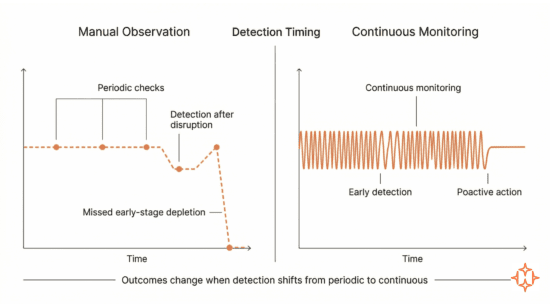
As a result, replenishment action is usually reactive.
Internal reviews across retail networks often show that:
- Staff respond only once a gap becomes obvious
- Early depletion stages go unnoticed
- The costliest stock-outs are the ones that were visible briefly, then missed
Traditional audits and manual checks simply do not operate at the speed of high-velocity shelves.
The difference is not in effort, but in how and when the system detects change:
| Aspect | Manual Shelf Observation | Continuous Shelf Visibility System |
| Detection timing | After shelf appears visibly empty | During early-stage depletion |
| Inventory signal | Based on transactions and stock records | Based on real-time shelf state |
| Monitoring frequency | Periodic and inconsistent | Continuous and real-time |
| Focus of attention | Spread across all shelves | Prioritised based on SKU velocity and risk |
| Trigger for action | Reactive to visible disruption | Proactive based on predicted stock-out risk |
This gap in detection timing is what turns normal shelf movement into missed sales.
Cost of “late” replenishment
Not all stock-outs are equal.
A shelf that is empty for 10 minutes behaves very differently from one that is empty for 2 hours.
Across categories:
- Even 15–30 minutes of stock-out in high-velocity SKUs can materially impact daily sales
- Customers substitute, postpone, or abandon purchases
- Repeated exposure to broken shelves erodes store perception over time
In several large formats, internal data shows that up to 20% of lost sales from stock-outs occur before teams are even aware a problem exists.
Beyond a certain point, replenishment does not recover lost demand, only restores shelf condition.
By the time replenishment happens, the damage is already done.
Replenishment is a visibility problem, not a manpower problem
A common reaction to replenishment issues is adding checks or increasing staff responsibility.
In practice, this rarely scales.
What changes outcomes is earlier detection, not harder effort.
Retailers that improve replenishment performance focus on:
- Detecting shelf disruption as it begins
- Acting before the gap becomes obvious to customers
- Prioritising high-velocity SKUs and zones
This shift consistently delivers better results than increasing audit frequency or staff workload.
How camera analytics fixes this
Camera analytics introduces continuous visibility where manual checks cannot.
Instead of relying on human observation, retailers can:
- Monitor shelf state in high-traffic zones
- Detect partial depletion before full stock-out
- Track how long shelves remain disrupted
- Prioritise action based on velocity and impact
Across deployments, retailers typically uncover that:
- The same shelves break repeatedly
- Gaps cluster around specific times of day
- Replenishment delays are structural, not random
What was previously anecdotal becomes measurable.
What changes when this gap is addressed
In practice, this is where systems like HipHip.AI come in. By using camera feeds to continuously analyse shelf conditions, it identifies where and when replenishment is required and converts that into clear, store-level actions.
- SKU-level shelf risk, not just aisle-level visibility
- Impact-based alert prioritisation
- Live queue of shelves needing attention
- Actions aligned to current demand
This ensures that visibility does not remain observational, but consistently translates into timely, high-impact replenishment decisions.
For retailers evaluating how to reduce store-level replenishment gaps, the shift begins with improving how and when shelf-level disruption is detected.
Closing thoughts
Most replenishment systems are designed around stock levels. But shelves do not fail when stock runs out. They fail when depletion goes unobserved.
This is why the same stores, with the same inventory and planning logic, continue to see repeat breakdowns on the same SKUs, at the same hours. The issue is not availability. It is the absence of a mechanism that captures when a shelf is drifting out of sync with demand.
Until that layer exists, replenishment will remain structurally reactive, regardless of how much process is added on top.
The shift is not operational. It is perceptual. It begins with seeing the shelf not as a static state, but as a system that is continuously moving with demand.
About HipHip.AI
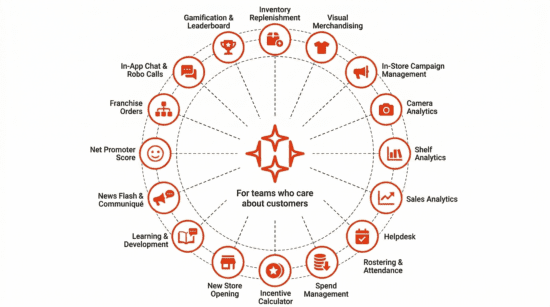
HipHip.AI is an AI-powered, end-to-end retail execution platform used across 10,000+ retail brick and mortar stores. It unifies inventory, merchandising, campaign management, store teams, and store spend into a single operating system—enabling real-time visibility and execution across stores.
Core capabilities include:
- Inventory Replenishment
- Visual Merchandising
- In-Store Campaign Management
- Camera Analytics
- Shelf Analytics
- Sales Analytics
- Helpdesk
- Task Manager
- Rostering & Attendance
- Spend Management
- Incentive Calculator
- New Store Opening
- Learning & Development
- News Flash & Communiqué
- Net Promoter Score
- Franchise Orders
- In-App Chat & Robo Calls
- Gamification & Leaderboard
HipHip.AI integrates seamlessly with existing POS, ERP, WMS, and HRMS systems, ensuring zero disruption to current infrastructure while unlocking smarter, faster retail execution.
Talk to an expert → hiphip.ai
Frequently asked questions
Why do replenishment failures occur even when inventory is available?
Because the issue is rarely stock availability. Failures typically occur when shelf-level depletion is not detected early enough, leading to missed selling windows despite inventory being present in the backroom or warehouse.
What makes high-velocity SKUs more prone to replenishment breakdowns?
High-velocity SKUs deplete faster and experience more customer interaction, which means their shelf condition can deteriorate rapidly within short time windows. This makes delayed detection significantly more costly.
What is the difference between early-stage depletion and a stock-out?
Early-stage depletion refers to the phase where a shelf is partially stocked but trending towards empty. A stock-out is the final state. Most revenue loss begins during early-stage depletion, not at the point of complete stock-out.
How does continuous shelf monitoring change replenishment outcomes?
It enables detection of disruption as it begins, allowing store teams to act within the selling window rather than after the shelf has already gone empty.
What kind of patterns are typically invisible without continuous visibility?
Recurring breakdowns at specific hours, SKU-level volatility in high-traffic zones, and consistent delays in certain store areas often go unnoticed without continuous monitoring.
Why do the same shelves tend to break repeatedly?
Because the underlying issue is structural, not random. Without continuous detection and pattern tracking, the same gaps reoccur under similar conditions.
Related reads:
- What retailers are doing differently to fix replenishment at scale
- Why most forecasts fail at the store level—and how to fix it
- The real logic behind allocating new SKUs across stores
- How retailers avoid overstocking and stockouts during peak seasons
- What early risk signals look like at SKU and store level